


How to Clean Teak Furniture for a Lasting Finish
That beautiful, golden-brown teak furniture on your boat deck or patio isn't just an accessory, it's a statement. But keeping it looking its best means cleaning it the right way. The key is to use a gentle, pH-neutral cleaner and a soft-bristle brush, always scrubbing with the grain. This simple approach gets rid of the grime and mildew without stripping away the wood's natural, protective oils.
Why Proper Teak Care Protects Your Investment

Your teak furniture is a serious investment, chosen for its rugged durability and classic good looks. It's so popular, in fact, that the global teak furniture market hit an incredible USD 58.9 billion in 2023. That popularity is a testament to its value. You can find more details on the global teak market on cognitivemarketresearch.com.
But the harsh marine environment, with its constant sun, humidity, and salt spray, can really do a number on it.
Over time, that exposure turns the wood's rich, golden hue into a silvery-gray patina. While some people don't mind the weathered look, it's actually a sign of surface oxidation and often comes with damaging mildew and dirt ground deep into the grain.
Beyond Appearance: The Importance of Maintenance
Letting your teak go is about more than just looks; it's about protecting the wood's structural integrity. When dirt and moisture work their way into the grain, they create the perfect breeding ground for mold and mildew, which can eventually lead to rot. At the same time, all that UV exposure breaks down the natural oils that make teak so tough in the first place.
This isn't just a cosmetic issue. Neglecting your furniture can easily slash its lifespan by up to 50%.
This guide is more than just a few cleaning tips; it's a complete strategy for preservation. We'll walk you through how to properly clean, restore, and protect your teak so it stays a source of pride for years.
Using the right products makes all the difference. A specially formulated cleaner, like our Better Boat Teak Cleaner, is designed to simplify the whole job. A dedicated teak cleaner will:
- Deep clean without harsh chemicals that can dry out and damage the wood.
- Remove stubborn grime and ugly mildew stains far more effectively than soap.
- Prepare the surface perfectly for any protective treatments like sealers or oils.
By learning how to clean teak furniture the right way, you’re not just scrubbing away dirt. You’re safeguarding a valuable asset and making sure it continues to look great on your boat, season after season.
Assembling Your Teak Cleaning Toolkit
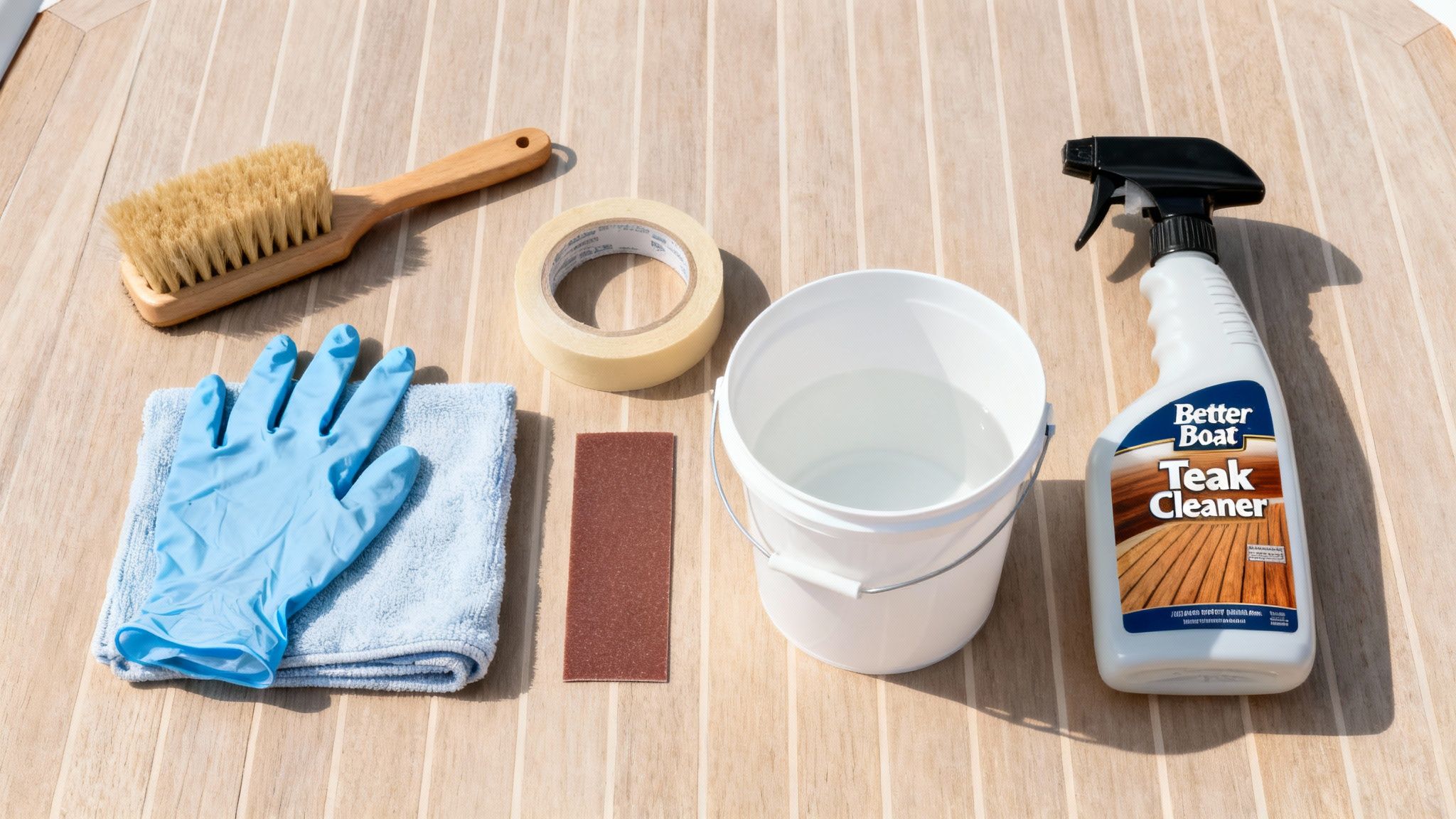
Before you even think about getting your teak wet, the secret to a flawless finish is having the right supplies ready to go. I've seen it countless times, someone grabs a generic household cleaner or a stiff kitchen scrubber, and the results are disastrous.
Harsh, all-purpose chemicals can strip teak of its natural protective oils, leaving it brittle and vulnerable. And scrubbing too aggressively? That can permanently scar the wood grain. A little prep work up front ensures the whole process is safe and effective for your prized furniture or boat deck.
Choosing the Right Cleaning Agent
If there's one thing you don't want to compromise on, it's your cleaning solution. Standard boat soaps or household detergents are often too alkaline or acidic, which can lead to discoloration and cause the wood to age prematurely. You need a pH-balanced cleaner made specifically for teak.
Purpose-built teak cleaner
Teak Cleaner and
A pH-balanced formula designed specifically for teak protects the wood's natural oils while cutting through salt, grime, and mildew. The Teak Cleaner and Brightener handles routine cleaning, while the full Brightening and Sealer Set covers every step from clean to protected in one kit.

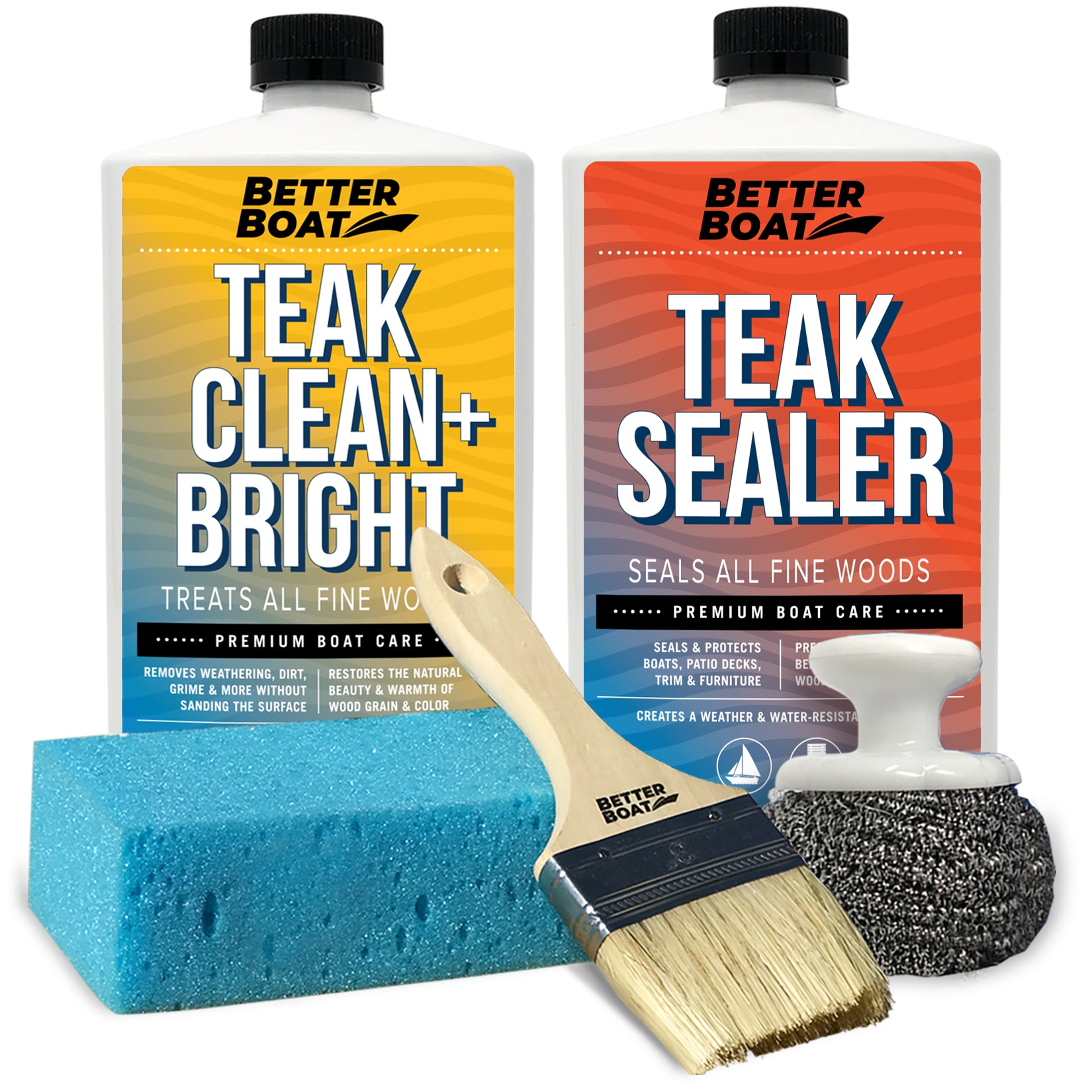
A dedicated teak cleaner is formulated to cut through the tough stuff, salt residue, stubborn grime, and mildew, without damaging the wood itself. Our Better Boat Teak Cleaner is a perfect example; it’s designed to restore that beautiful, natural honey color safely.
Your Essential Teak Cleaning Toolkit
You don't need a professional workshop to get professional results. Just a few carefully chosen tools will make all the difference. To make it easy, we've put together a quick checklist of the must-haves for your project.
| Your Essential Teak Cleaning Toolkit |
|---|
| Gather these supplies for a safe and effective cleaning process. We've included notes on what to use and, more importantly, what to avoid. |
| Tool or Product |
| Why It's Essential |
| Our Recommendation |
| Teak Cleaner |
| A pH-balanced formula that cleans without stripping natural oils. Avoid harsh household detergents. |
| Our Better Boat Teak Cleaner is engineered specifically for this job. |
| Soft-Bristled Brush |
| A non-metallic, soft brush is crucial. It lifts dirt from the grain without scratching the surface. |
| For larger areas like decks, a purpose-built set like our stainless steel scrub set is a game-changer. |
| Two Buckets |
| One bucket holds your cleaning solution, and the other has clean water for rinsing. This prevents cross-contamination. |
| Any two sturdy 5-gallon buckets will do the trick. |
| Protective Gloves |
| Protects your hands from cleaning solutions and prolonged water exposure, preventing dry, cracked skin. |
| A simple pair of waterproof rubber or nitrile gloves is perfect. |
| Clean Rags or Sponges |
| Microfiber cloths are great for applying cleaner, wiping down surfaces, and drying without leaving lint behind. |
| Look for a multi-pack of high-quality microfiber towels. They're endlessly useful on a boat. |
| Painter's Tape |
| A pro tip! Use it to protect surrounding hardware, fiberglass, or caulking from accidental contact with the cleaner. |
| Any reputable brand of blue painter's tape will work. It sticks well but removes cleanly. |
With these items at your side, you're set up for success. You won't have to stop mid-project to search for a tool, making the whole process smoother and more efficient.
A Practical Guide to Cleaning Teak Furniture
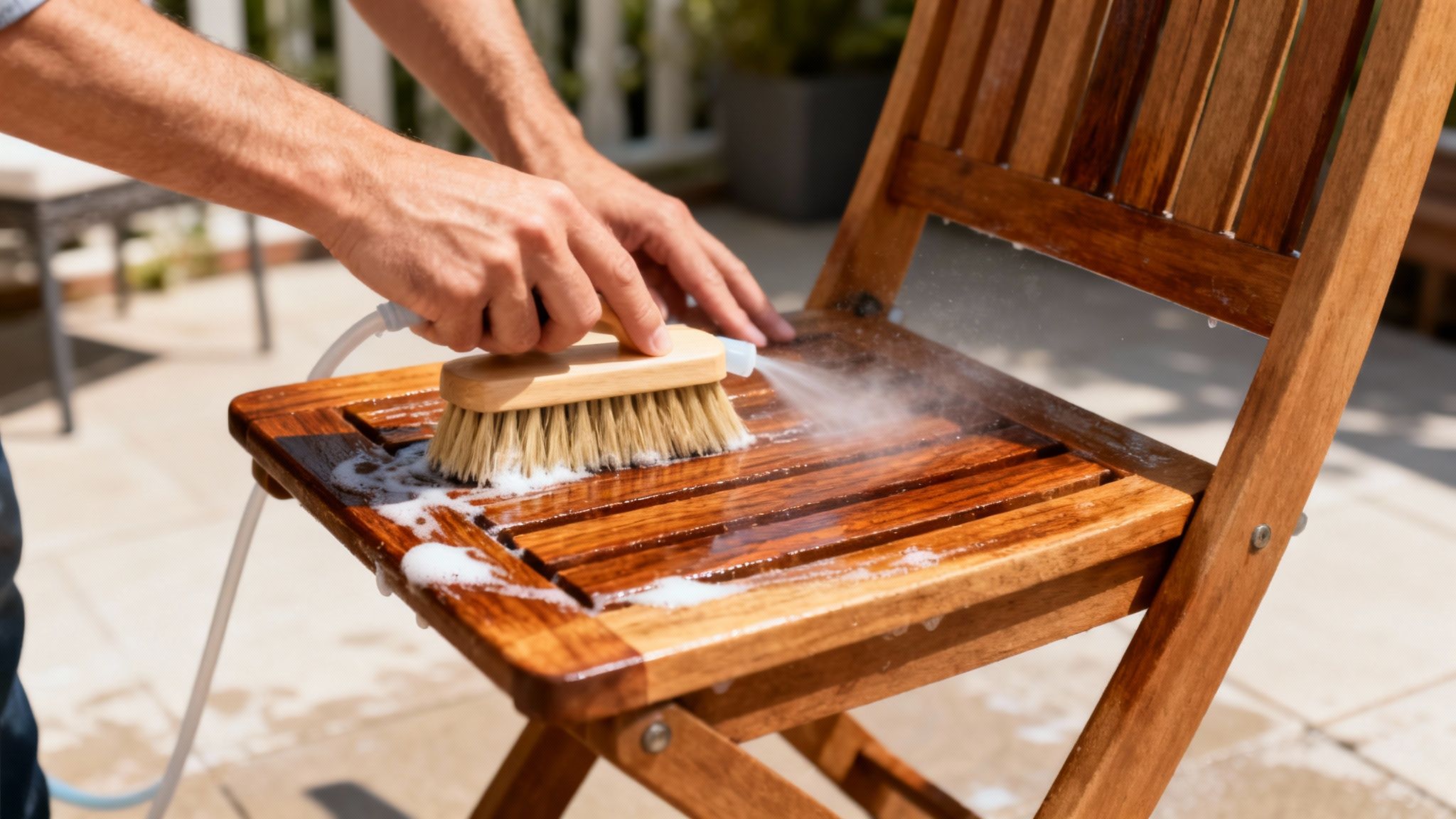
Alright, you've got your gear ready, so let's get down to business. Cleaning teak isn't about scrubbing until your arms give out; it's more about finesse. We're going to walk through the entire process, focusing on techniques that cut through the grime and mildew without damaging the wood grain or stripping away its natural oils.
Think of these steps as a flexible guide, not a strict set of rules. Your goal is simple: get your teak looking fantastic again while protecting your investment for the long haul.
Starting with a Gentle Rinse
First things first: give your teak furniture a good rinse with a regular garden hose. This might seem like a small step, but it’s more important than you think. You’re washing away all the loose surface crud, salt, dust, pollen, that would otherwise get ground into the wood grain when you start scrubbing.
Work from the top of the furniture down, making sure every surface gets completely wet. This pre-soak helps the wood absorb your cleaning solution evenly, which is key to avoiding a blotchy, uneven finish later. Don't be tempted to skip this part; it sets you up for a much better deep clean.

Applying Your Teak Cleaner Correctly
Once the furniture is damp, it's time for the cleaner. Our Better Boat Teak Cleaner is formulated specifically for the tough conditions of a marine environment, but it works wonders on patio furniture, too. Mix your solution in a bucket of clean water, following the directions on the bottle.

The right scrubbing tool matters
Stainless Steel Scrub Set for Teak Decks with Handle
A dedicated stainless steel scrub set with a handle lets you work the cleaner into the grain along its natural direction without tearing the wood fibers. The ergonomic handle reduces fatigue so you stay consistent across the whole surface.
Using a sponge or soft cloth, apply the cleaner generously. It's best to work in smaller, manageable sections. The key here is to keep the surface wet with the cleaning solution. If you let it dry on the wood, you’re asking for streaks and stains that are a real pain to remove.
Here's a pro tip that can save you a lot of grief: always scrub with the grain of the wood, never against it. Use long, gentle strokes. This simple technique lifts dirt out of the grooves instead of scratching or roughing up the soft surface of the teak.
Without a good cleaning, teak exposed to sun and salt can oxidize and turn that familiar silvery-gray in as little as 3-6 months. A proven professional approach is to mix one part teak cleaner to about ten parts water. The pH-balanced formula in our cleaner sits around 7.5, perfect for tackling those stubborn black streaks. Let the solution sit for 5-10 minutes, then agitate it with a nylon pad and rinse it all off thoroughly.
The Great Pressure Washer Debate
We get this question all the time: "Can't I just pressure wash it?" It seems like a fast and easy solution, but using a pressure washer on teak is almost always a bad idea. High-pressure water can be incredibly destructive.
High PSI can literally tear away the soft parts of the wood grain, leaving you with a fuzzy, splintered surface. Do this enough, and you can reduce the thickness of your wood by as much as 15% over time, seriously shortening its lifespan.
If you absolutely have to use a pressure washer for something huge like a deck, you need to be extremely careful. Follow these rules to the letter:
- Use the lowest pressure setting possible. Stay under 1200 PSI.
- Use a wide-angle spray tip, a 40-degree nozzle or wider.
- Keep the nozzle at least 12-18 inches away from the wood at all times.
- Never stop moving. Keep the wand in constant, sweeping motions that follow the wood grain.
For most projects, though, a soft brush and a little patience will give you a much better, and safer, result. If your cleaning needs go beyond just teak, you can always look into professional furniture cleaning services. By following this workflow, you can bring back your teak's natural glow without causing any damage.
Bringing Weathered Teak Back to Life
There comes a time when a simple cleaning just won't cut it. Maybe your teak has weathered to that classic silvery-gray, or it's developed a rough, tired texture after seasons of use. When this happens, you’re moving from routine maintenance into full-on restoration.
The great news? That gray, weathered layer is only on the surface. With the right approach, you can peel back the years of sun, salt, and rain to reveal the beautiful, golden-brown wood hiding just underneath. This process really boils down to two key steps: brightening the wood to bring back its color and a light sanding to make it feel smooth again.
Using a Teak Brightener to Restore Color
After giving your teak a thorough cleaning, you might notice it still looks a little dull or washed out. This is where a teak brightener becomes your best friend. A common myth is that brighteners are harsh bleaches, but that's not the case. They're actually acid-based neutralizers specifically formulated to counteract the alkaline properties of most teak cleaners.
This simple chemical reaction works magic on that stubborn gray patina, lifting it away to let the teak’s natural honey tones shine through. Applying a brightener is a must-do for any piece of teak that's been heavily weathered. It also preps the wood's surface by opening up the grain, which is critical for making sure any oils or sealers you apply next will absorb evenly and give you long-lasting protection.
If you're looking for an all-in-one solution that takes the guesswork out of this, you can revitalize old teak with the teak cleaner set from Better Boat. It has everything you need for both the cleaning and brightening stages.
A brightener doesn't just improve the color; it chemically balances the wood's surface after cleaning. Skipping this step can lead to a blotchy finish when you apply a protective sealer or oil.
Smoothing the Surface with Light Sanding
Once you’ve cleaned and brightened the wood, run your hand over the surface. You'll probably feel a slightly rough or "fuzzy" texture. Don't worry, this is completely normal. The deep cleaning process often raises the wood grain, but it's an easy fix with some light sanding. This final touch is what creates that perfectly smooth, professional-looking surface.
For this job, you'll want to grab a fine-grit sandpaper, something like 120-grit or higher is perfect. Stay away from coarser grits, as they're way too aggressive and will just scratch the wood.
Just follow these simple guidelines for a flawless finish:
- Always sand with the grain. Follow the natural lines of the wood with long, even strokes. If you sand against the grain, you’ll end up with a mess of visible scratches.
- Use gentle pressure. You're not trying to strip layers of wood off. Just let the sandpaper do the work to knock down that raised grain.
- Wipe away dust. When you're done, use a clean, dry microfiber cloth to wipe away all the sanding dust. You want a perfectly clean surface before moving on to the final protection step.
This careful sanding doesn't just make the furniture feel better to the touch; it also removes any final little imperfections and creates the ideal canvas for a beautiful, protective finish.
Protecting Your Teak: The Oil vs. Sealer Debate

Seal in your hard work
Teak Sealer Oil
After cleaning and brightening, a quality teak sealer oil locks out moisture and blocks UV rays to keep that restored honey color from graying back out. Applied correctly once or twice a season, it dramatically reduces how often a full clean is needed.
You've put in the elbow grease to clean, brighten, and maybe even sand your teak back to its former glory. Now for the most important step: protecting it. This last part is all about creating a tough barrier against the elements, which will save you a ton of work down the road.
You’ve got two main choices here: go with a traditional teak oil or use a more modern teak sealer. There's a lot of back-and-forth on which is better, but the right answer really comes down to the look you're after and how much time you want to spend on upkeep.
Understanding Traditional Teak Oil
Teak oil is what’s known as a penetrating finish. It soaks deep down into the wood, replenishing the natural oils that get lost over time. This is how you get that classic, warm glow that makes brand-new teak furniture so stunning. It really makes the grain pop.
But that beautiful finish comes with a catch: maintenance. Teak oil offers very little protection against UV rays and moisture, so it breaks down fast, especially on a boat or in a sunny backyard. To keep that rich, "wet look," you'll find yourself reapplying it every few months. For a deeper dive, you can learn more about the specifics of using teak oil for boats in our detailed guide.
The Modern Approach with Teak Sealers
A teak sealer, on the hand, works completely differently. Instead of soaking in, it forms a protective film right on the surface of the wood. It creates a durable shield that locks out moisture and, most importantly, is packed with UV inhibitors that stop the sun from turning your beautiful teak gray.
This makes sealers a much more durable, long-lasting option. One good application can last an entire season, or even longer. For many boat and homeowners, it's a "set it and forget it" solution. While you won't get the same deep, oily luster, sealers do an excellent job of locking in the wood's natural honey color.
Choosing between oil and sealer is a classic tug-of-war between looks and practicality. Oil gives you that deep, rich finish but demands frequent reapplication. A sealer offers superior, long-lasting protection with way less maintenance, making it a clear winner for harsh marine environments.
Teak Oil vs Teak Sealer: Which Is Right for You?
Use this side-by-side comparison to choose the best protective finish for your teak furniture based on your goals and maintenance preferences.
| Consideration | Teak Oil | Teak Sealer |
|---|---|---|
| Look & Finish | Deep, rich, "wet look" that darkens the wood and enhances the grain. | Preserves the natural honey color of new or cleaned teak. More of a matte or satin finish. |
| Protection | Primarily nourishes the wood. Offers minimal UV and moisture protection. | Creates a surface barrier. Provides excellent UV protection to prevent graying and locks out moisture. |
| Durability | Low. Breaks down quickly, especially in sun and rain. | High. A single application can last a full season or longer, even in harsh conditions. |
| Maintenance | High. Needs reapplication every 2-4 months to maintain its look and protective qualities. | Low. Typically requires reapplication just once per year. |
| Best For | Indoor furniture, or outdoor pieces in sheltered areas where high maintenance is acceptable for a specific aesthetic. | Boats, outdoor patio furniture, and any teak exposed to direct sun and weather. |
Ultimately, if you're dealing with teak that lives outside, especially on a boat, a sealer is almost always the more practical choice. It simply holds up better to the abuse of sun and water.
This decision tree gives you a great visual for the whole restoration journey, from weathered and gray to beautifully finished.
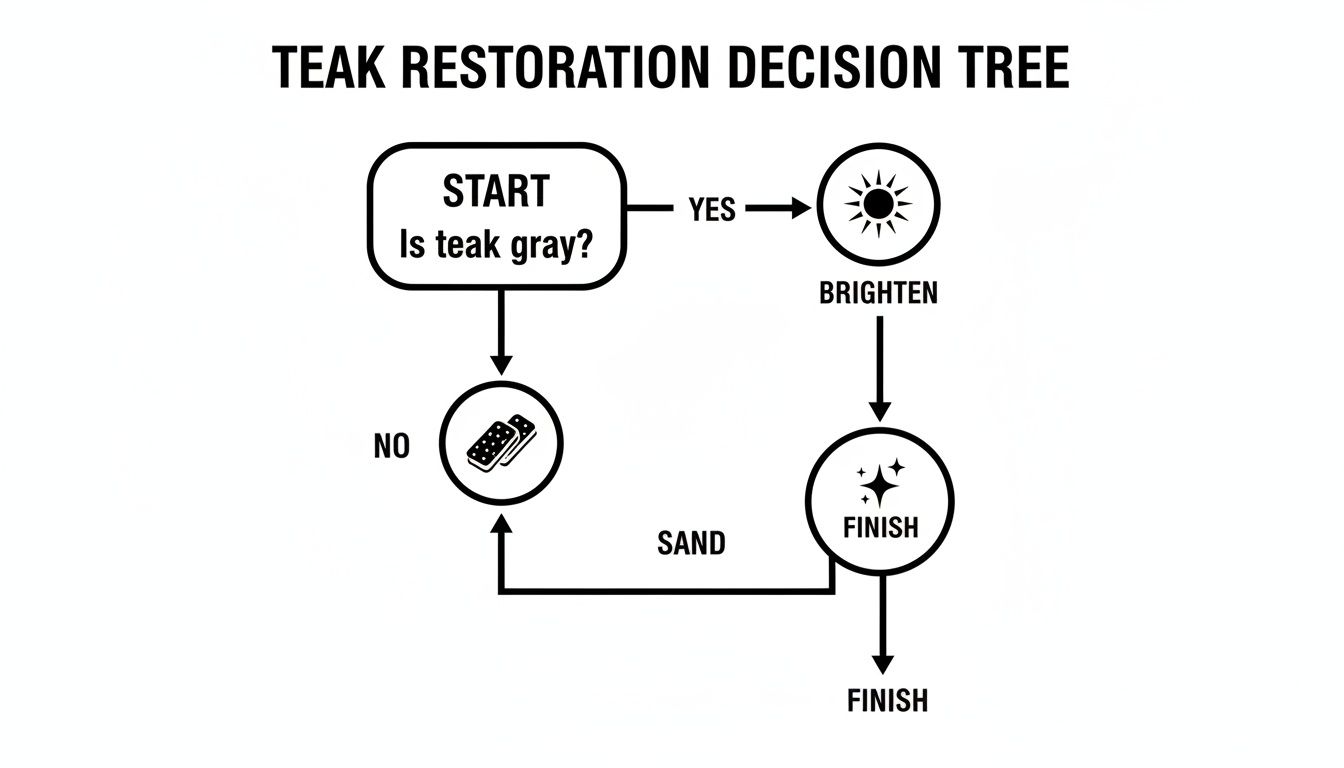
The key takeaway here is that your starting point determines the path. Sometimes a good brightening is all you need, while other times you'll need to sand before you can even think about applying that final protective coat.
After you've done the hard work, it’s crucial to safeguard your investment. For more comprehensive insights on safeguarding your pieces, check out this ultimate guide to protecting wood furniture from scratches and stains.
Your Top Teak Care Questions, Answered
Even with the best game plan, questions are bound to come up when you're dealing with teak. I've been there. This section is your go-to reference for the most common hurdles boaters and homeowners face. Think of it as a quick chat with an expert to get you straight answers.
How Often Should I Really Clean My Boat's Teak?
Honestly, it all comes down to where your boat lives. If your teak is constantly getting hit with salt spray and sun, a deep clean is a must at least twice a year. A great time to do this is at the start and end of your boating season. This is when you'll want to break out a dedicated product like our Better Boat Teak Cleaner to really cut through the season's grime.
Between those big cleanings, get into the habit of giving your teak a quick freshwater rinse after every trip. It's a simple step that makes a huge difference by washing away corrosive salt before it can settle in. If you spot any mildew starting or notice it graying faster than you'd like, tackle it then and there. Don't wait.
A little proactive care goes a long way. Trust me, a quick spot-clean now will save you hours of heavy scrubbing down the road.
Can I Actually Bring Back Teak That's Gone Completely Gray?
Yes, absolutely! It’s one of the most common questions I get. That silvery-gray patina isn't damage or a permanent stain. It's just a thin layer of oxidized wood fibers on the surface. While it's a natural sign of weathering, it's 100% reversible.
Bringing it back to that beautiful honey color is usually a two-part mission:
- First, a deep cleaning with a proper teak cleaner lifts off that gray, oxidized layer and gets rid of any embedded dirt or mildew.
- Next, a teak brightener works its magic, neutralizing the cleaner and revealing the wood's natural, warm glow again.
If the wood has gotten rough and splintery from years of exposure, a light sanding after cleaning and brightening will make it feel brand new. This gives you a perfectly smooth canvas, ready for a fresh coat of oil or sealer.
Help! How Do I Get Food or Red Wine Stains Out of My Teak?
We've all been there, enjoying a nice dinner on the deck when a glass of wine takes a tumble. The single most important thing to remember is to act fast.
The second a spill happens, blot it up with a clean, dry cloth. Don't rub, just blot. For a stain that's already started to set in, mix a little of our Better Boat Teak Cleaner with water to form a paste. Apply it right on the spot, let it sit for a few minutes, then give it a gentle scrub with a soft-bristled brush. Once you see the stain lifting, rinse the whole area thoroughly with fresh water.
Should I Bother Using a Cover for My Teak Furniture?
Using a cover is probably the single best thing you can do to protect your teak, especially during the off-season or long stretches when you're not using it.
Think of a quality cover as a shield against teak's two biggest enemies: UV rays and moisture. By keeping the sun and rain off the wood, you seriously extend the life of your finish. This means less frequent deep cleans and re-oiling for you. The key is to get a breathable, waterproof cover. This is non-negotiable. A breathable cover lets air circulate, preventing moisture from getting trapped underneath and turning into a mildew problem.
At Better Boat, our goal is to give you the products and know-how to protect your investment. Our specially formulated Teak Cleaner is the perfect first step toward keeping your furniture beautiful and strong for many seasons to come.
Restore Your Teak's Natural Beauty with Better Boat Teak Cleaner Today!


