


Best Boat Hook Poles and How to Choose the Right One

At a glance
The best boat hook pole fits the reach, freeboard, storage space and thread a boat needs. For many boaters, a lightweight telescoping pole with a floating hook head and a standard 3/4 inch Acme thread is a practical choice.
- Measure reach from the bow, midship and helm, then size to the longest one.
- Telescoping poles collapse to fit a locker, while wood is heavier and harder to store.
- A Hook Only head threads onto a standard 3/4 inch Acme threaded pole.
Contents (11 sections)
- What Is a Boat Hook Pole?
- What Do You Use a Boat Hook For?
- Types of Boat Hook Poles
- How Long Should a Boat Hook Be?
- Boat Hook Poles Compared
- Boat Hook Heads and the 3/4 Inch Acme Thread
- Boat Hook Pole Accessories
- Using a Boat Hook Pole Safely
- Boat Hook Pole Maintenance and Storage
- Build a Complete Docking Setup
- Frequently Asked Questions

Top Pick
Boat Hook with Standard End ( With or Without Pole )
Grab dock lines, push off, and control distance while keeping both feet in the boat.
View productThe best boat hook pole depends on the reach, freeboard, storage space and attachment compatibility a boat needs. For many boaters, a lightweight telescoping pole with a floating hook head and a standard 3/4 inch Acme thread is a practical choice. It can reach a cleat, piling or mooring buoy, collapses to fit a locker, and lets the hook be swapped later without replacing the whole pole.
A boat hook pole is also called a boat pole, docking pole or dock hook pole. It is useful for passing a dock line to someone on shore, pushing gently away from a piling, or fishing a dropped item out of the water. Wooden poles still suit some larger boats and traditional setups. This guide covers both types, how to think about length, how the 3/4 inch Acme thread works, seven picks compared, and how to care for and store the pole.
What Is a Boat Hook Pole?
A boat hook pole is a pole fitted with a hook head that can pull in lines or objects, plus a blunt or padded surface used for pushing. Poles can be fixed, telescoping or wooden, and lengths vary widely by model.
The hook is used most for placing a dock-line loop over a cleat or passing a line through a mooring ring, and for pulling a mooring buoy within reach. The blunt or padded part pushes off a dock, piling or seawall. People searching for the hooks on a boat sometimes mean the hook head on this pole, while the fixed hardware a line ties to is a cleat. See the guide to dock cleats for that side of the job.
This guide is about hand-held boat hook poles. It does not cover shallow water anchors sold as power poles, and it does not cover fishing hooks.
What Do You Use a Boat Hook For?
A boat hook gives reach that arms alone do not, which keeps a boater from leaning dangerously over the side. These are its main jobs.

| Function | Description | When You Will Use It |
|---|---|---|
| Docking & Mooring | Grabbing dock lines, cleats, and mooring rings from a distance. | Approaching a slip, tying up alongside a pier, or picking up a mooring ball. |
| Fending Off | Pushing gently off docks or pilings to reduce contact and scrapes. | Maneuvering slowly in tight marinas and slips. |
| Retrieving Items | Snagging lines, fenders, hats, or other gear that has fallen overboard. | Anytime something important lands in the water. |
| Testing Depths | Gently probing unclear depths in shallow, calm water (with caution). | Carefully approaching a bank or an unfamiliar shallow anchorage. |
More Ways to Use a Boat Hook Pole
- Retrieving overboard objects. Hook the strap, handle or fabric and lift it out.
- Testing water depth. On rivers or lakes, the blunt end can gauge whether the water is deep enough to get close to the bank. Use it gently and never rely on it in unknown water.
- Passing items to people on shore. A forgotten coat or bag can be handed across a small gap on the hook.
- Handing lines to nearby boats. When rafting up alongside another boat that is already secured, the hook is a safe way to pass a line across.
- Pushing off banks, quays and pilings. At low speed and in close quarters, a gentle push keeps the hull off the bank or dock. Avoiding other vessels is a job for the helm and throttle. Never place hands, limbs or a pole between moving boats.
- Pulling a dinghy closer. Hook the painter line instead of straining to reach it.
- Nudging fenders. Slide a fender into the exact spot where contact will happen as the boat approaches. Fender Lines make the fender easy to set at the right height.
A boat hook pole is not a rescue device. If a person goes overboard, follow the boat's person-overboard procedure and use a throwable flotation device. A boat hook pole is also not a tool for freeing a grounded boat. If a boat runs aground, follow the boat and engine manufacturers' procedures and call a qualified towing service when needed. For boarding from a bank or across a gap between the boat and shore, use a secured gangway or boarding plank with handholds and nonslip footing. A pole planted in the water is not a safe balance aid. For step-by-step technique when coming into a slip, see the guide on how boat hooks are essential for docking.
Types of Boat Hook Poles
The main choices are wooden, fixed aluminum or fiberglass, and telescoping. Some poles also float, which helps if one goes overboard.
Which pole type fits your boat?
Wooden
Sturdy and traditional, often floats, but heavy, fixed length and harder to store.
Telescoping aluminum
Light and adjustable, collapses into a locker, but flexes more and the lock needs regular checks.
Fixed aluminum or fiberglass
Simple with no moving parts. Fiberglass will not dent; aluminum is light and rigid.
Wooden vs. Telescoping Boat Hook Poles
Wooden Boat Hook Poles
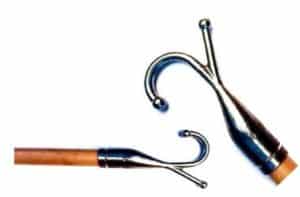
- Sturdy. Often made of pine or poplar, wood is hard-wearing and stands up to the elements.
- Traditional. A wooden pole suits classic boats and handles docking, fending off and retrieving gear.
- Often floats. Many wooden poles float, but check the manufacturer's flotation information for the finished pole.
- Heavy. Wood is heavier than aluminum.
- Fixed length. It cannot be adjusted for each job.
- Harder to store. A long fixed pole is awkward on smaller vessels.
Telescoping Boat Hook Poles
- Lightweight. Aluminum poles are light, which makes them easy for most crew members to handle.
- Adjustable. The length changes to suit each job.
- Easy to store. The pole collapses to fit a locker.
- Less rigid. A telescoping pole can flex more than a solid wooden pole when pushing off.
- Weak points. Inspect the locking mechanism and the hook head often, since they are the moving and load-bearing parts.
Aluminum vs. Fiberglass
- Aluminum. Aluminum has an excellent strength-to-weight ratio, light enough to handle easily yet rigid enough for pushing off. Anodizing turns the aluminum surface into a hard oxide layer that helps it resist saltwater corrosion.
- Fiberglass. Fiberglass is tough and will not dent like aluminum. Do not treat any boat hook as safe near electrical lines or equipment, since a wet, dirty or metal-fitted pole can conduct electricity. It is a bit heavier, and it can become brittle if left in the sun for years without care.
Some poles use carbon fiber composites; check the manufacturer's specifications for weight and strength. A quality aluminum or fiberglass pole suits most boats.
Fixed vs. Telescoping
A fixed pole is like having one screwdriver in the toolbox. It may be right for a cleat at the helm but too long on the bow or too short for a mooring ball. A telescoping pole extends for reach and shortens for close-quarters work and storage. Check its maximum length against the boat's freeboard and dock height.
Which pole fits your boat
Wooden
Sturdy and traditional, but heavy, fixed length and harder to store.
Telescoping
Lightweight, adjustable and collapses to fit a locker.
Aluminum
Light yet rigid enough for pushing off.
Fiberglass
Tough and will not dent, but a bit heavier.
How Long Should a Boat Hook Be?
The goal is to finish the job without leaning over the side, so err toward a pole with some extra reach. Boat length alone does not decide the right pole, and no single length fits every boat. These factors matter most.
- Freeboard. A higher side means a longer reach down to the water or up to a dock.
- Beam. A wider boat puts the cleat farther from where the crew stands.
- Dock height. Tall pilings and high docks call for more length.
- Working position. Bow, midship and helm positions each need a different reach.
- Storage. The pole has to fit the locker or clips available aboard.
Smaller boats with low sides usually do well with a shorter pole, while larger boats with high freeboard and wide beams call for more reach. An adjustable pole covers more situations than a fixed one, as long as its full length gives enough reach for the boat.
Choosing a Boat Hook for a 25 Foot Boat

For a 25 foot boat, including a center console, a telescoping pole is often a practical choice, but freeboard, working position, dock height and storage decide the length. Measure the distance from where a crew member stands on deck to the dock surface or cleat, using the boat's own freeboard and the typical dock height at its slip. Choose a pole whose extended length covers that reach with room to spare, and make sure it collapses short enough to store in a locker or on clips. Repeat the measurement from the bow, midship and helm, and size the pole to the longest reach.
Size your pole in four checks
- Measure from where the crew stands to the dock surface or cleat
- Repeat the measurement from the bow, midship and helm
- Size the pole to the longest reach, with room to spare
- Confirm it collapses short enough for a locker or clips
The Better Boat Hook and Rod pole adjusts from 3.5 to 6 feet, which suits close work. Boaters who need more reach can choose the Hook Only option and thread it onto a longer 3/4 inch Acme pole.
Boat Hook Poles Compared
The Better Boat Boat Hook is this guide's Top Pick for its floating hook and standard 3/4 inch Acme thread, sold as Hook Only or with an adjustable pole. The alternatives below, which include telescoping and wooden poles, are listed for reference rather than as tested or ranked recommendations. Their details change often, so check each current listing for length, materials and features before buying.
| Pick | Type | Notes |
|---|---|---|
| Better Boat Boat Hook (Top Pick) | Floating hook, Hook Only or Hook and Rod | Hook and Rod pole adjusts 3.5 to 6 feet. Hook Only fits an existing 3/4 inch Acme pole. |
| Windrider Telescopic | Telescoping | Check the listing for length and features. |
| DocaPole | Boat hook pole | Check the listing for length and features. |
| Shoreline Marine | Boat hook pole | Check the listing for length and features. |
| Eversprout Telescopic | Telescoping | Check the listing for length and features. |
| Davis Telescopic | Telescoping | Check the listing for length and features. |
| Acquah's Enterprise Wooden | Wooden | Check the listing for length and features. |
1. Better Boat Boat Hook (Top Pick)
The Better Boat Boat Hook is the top pick because it covers two common needs. Choose Hook Only to fit a standard 3/4 inch Acme threaded pole already on board, or choose Hook and Rod for the complete tool with an adjustable aluminum pole that extends from 3.5 to 6 feet. The hook floats and has visible blue accents, and a bright blue bumper helps cushion contact when pushing off docks or other surfaces. Boaters who need more reach than 6 feet can pair the Hook Only option with a longer compatible pole.
2. Windrider Telescopic Boat Hook Pole
A telescoping boat hook pole. Check the listing for length and features.
3. DocaPole Boat Hook Pole
A boat hook pole. Check the listing for length and features.
4. Shoreline Marine Boat Hook Pole
A boat hook pole. Check the listing for length and features.
5. Eversprout Telescopic Boat Hook Pole
A telescoping boat hook pole. Check the listing for length and features.
6. Davis Telescopic Boat Hook Pole
A telescoping boat hook pole. Check the listing for length and features.
7. Acquah's Enterprise Wooden Boat Hook Pole
A wooden boat hook pole. Check the listing for length and features.
Boat Hook Heads and the 3/4 Inch Acme Thread
Many boat hook heads screw onto the pole, and the thread type and diameter decide what fits. The Better Boat Boat Hook uses a standard 3/4 inch Acme thread and works with poles that have the same thread. Some other marine attachments, such as docking loop adapters, brush heads or squeegees, also use this thread, but that varies by brand. Verify both the thread type and the diameter on any pole and attachment before buying.
A cracked or lost hook head does not mean buying a new pole. The Better Boat Boat Hook in the Hook Only option is made for a pole that already has a 3/4 inch Acme thread, and the hook floats if it comes off and goes overboard. It comes as Hook Only for a pole already on board, or as Hook and Rod with an adjustable aluminum pole.

Boat Hook Pole Accessories
Docking Stick Adaptor
A docking loop adapter turns a boat hook pole into a boat loop, which makes it easier to drop a line over a bollard or cleat. It saves buying and storing a separate loop stick. Match any adapter to the pole's thread.
SeaLux Boat Hook Pole Clips
Mounting clips hold the pole against a gunwale or locker wall so it stays put underway and is easy to grab.
Brush, Squeegee and Mop Heads
Some brush, squeegee and mop heads can screw onto a compatible threaded pole, letting one pole pull double duty for washdowns and reaching the cabin top or hull sides. Check the thread type and diameter on the attachment before buying.

Better Boat pick
Boat Extension Rod for Mop and Brushes ( 3FT, 6FT and 9FT )
Universal 3/4 inch Acme threaded tip turns one pole into a handle for brushes, mop heads, squeegees and other standard heads. Choose 3FT, 6FT or 9FT.
View productUsing a Boat Hook Pole Safely
Pro tip. Before reaching toward a dock, extend the pole fully and confirm the lock holds.
The pole is a tool for guiding, not for wrestling a boat into place. The full process for dropping a loop over a cleat, picking up a mooring buoy and fending off is in the boat hook docking guide. These safety basics apply every time.
- Stay inside the boat. Overreaching is a mistake to avoid. Keep a low center of gravity and the body inside the gunwales, and let the pole do the work.
- Push, do not jab. Use the blunt or padded part of the head against the obstacle, and avoid the sharp point of the hook.
- Move slowly. Use the pole at low speed in close quarters, and keep hands and limbs clear of gaps between boats and docks.
- Lift smoothly. When recovering items, bring heavy waterlogged gear alongside first to avoid straining the pole.
Boat Hook Pole Maintenance and Storage
A pole seized with corrosion or fitted with a cracked hook is no help in a tight spot. A few minutes of care keeps it ready.
Rinse, Inspect and Clean
- Rinse after every trip. Fresh water flushes out salt crystals that can jam telescoping sections, which matters most for saltwater boaters.
- Inspect every few outings. Extend the pole fully and wipe it down. If the sections feel gritty, sticky or stubborn, salt or dirt has gotten inside. Check the lock, the hook head and any plastic parts for cracks.
- Wash when needed. Collapse the pole and wash it with boat soap and a soft brush, then rinse and let it air dry before storing.
- Protect wood and fiberglass. Keep wooden poles dry and out of long direct sun, and avoid leaving fiberglass in the sun for years without care.
Pole care after a trip
- RinseFlush with fresh water to clear salt from telescoping sections.
- InspectExtend the pole and check the lock, hook head and plastic parts for cracks.
- WashCollapse it and wash with boat soap and a soft brush when needed.
- DryLet it air dry before storing.
Where to Store It
A pole tossed on deck or buried in a locker gets stepped on, damaged or lost. A pair of mounting clips along a gunwale, inside a locker or under the cabin top works well.
- Protection. Clips keep shifting gear from bending the pole or cracking the hook head.
- Safety. A loose pole rolling around on deck is a tripping hazard.
- Access. When a line must be grabbed in a hurry, the pole is exactly where it belongs.
Build a Complete Docking Setup
A boat hook works best alongside good lines and dock protection. For everything at once, the Docking Essentials Kit bundles dock lines, fenders and a boat hook with rod.

Better Boat pick
1/2 Dock Lines 25FT
Replace tired dock rope with 1/2 inch lines made for heavier tie ups, busy slips, and changing water.
View product- Dock lines. The hook delivers the line, but the line does the work. Double braided nylon absorbs shock from wake, wind and dock surge, like the 1/2 inch dock lines. See the guide to dock lines and when to replace them.
- Dock bumpers. Dock bumpers and corner guards protect the dock edges, posts and slip corners where the hull is most likely to scrape. The pole can also nudge a fender into place, and the fender guide explains sizing.
Other gear worth having aboard is covered in the guide to boat accessories you need before heading out. Safety gear requirements vary, so check your state rules and US Coast Guard requirements for what your boat must carry. A few essential safety habits help in an emergency.
Frequently Asked Questions
Who makes the best boat hook pole?
The best pole depends on the reach, freeboard, storage space and attachment compatibility a boat needs. The Better Boat Boat Hook is this guide's top pick, with a floating hook and a 3/4 inch Acme thread, available as Hook Only or as Hook and Rod with an aluminum pole that adjusts from 3.5 to 6 feet. Boaters who need more reach can compare the other poles above or thread the Hook Only option onto a longer compatible pole.
What is the best boat pole for docking?
For docking, a boat hook pole is the usual choice. It lets the crew drop a dock line loop over a cleat, ease the boat in and push off without leaning over the gunwale. The Better Boat Boat Hook pairs a floating hook with an optional aluminum pole that adjusts from 3.5 to 6 feet. The full routine is in the boat hook docking guide.
What are the long poles on boats called?
The long pole kept on most boats is a boat hook, also called a boat hook pole or docking pole. It carries a hook head for grabbing lines and a blunt tip for pushing off. Fishing boats may also carry outriggers or push poles, which do different jobs.
What is the best telescoping boat hook?
A telescoping boat hook should lock firmly at each length, collapse short enough to store, and take a standard 3/4 inch Acme hook head. The Better Boat Boat Hook Hook and Rod option pairs a floating hook with an aluminum pole that adjusts from 3.5 to 6 feet, and the comparison above lists other telescoping poles to check.
Are wooden boat hook poles sturdy?
Yes. Wooden poles, often pine or poplar, are hard-wearing and stand up to the elements, which is why they suit traditional boats. The tradeoff is weight and a fixed length that is harder to store on a small boat.
What is a boat dock hook pole?
It is another name for a boat hook pole used at the dock. It is a pole with a hook head for grabbing dock lines and cleats and a blunt tip for pushing off. The boat hook docking guide covers how to use one when coming alongside.
How long should a boat hook be?
There is no single right length. Freeboard, beam, dock height, working position and storage space decide it. Choose a pole with enough reach that the crew never has to lean over the side, and prefer an adjustable pole if one length will not cover every job.
What length boat hook is best for a 25 foot boat?
A telescoping pole is the practical choice for a 25 foot boat, center consoles included. Measure from where the crew stands to the dock surface or cleat at the boat's freeboard and typical dock height. Pick a pole whose extended length covers that reach with room to spare and that collapses short enough to store. The Better Boat Hook and Rod pole adjusts from 3.5 to 6 feet, and the Hook Only head fits a longer 3/4 inch Acme pole for more reach.
Is a wooden or telescoping boat hook pole better?
Wood is sturdy, and many wooden poles float, but it is heavy and hard to store. A telescoping aluminum pole is lighter, adjustable and easier to stow. Many boaters choose telescoping for everyday use, while wood suits traditional setups.
What do you use a boat hook for?
A boat hook grabs dock lines, cleats and mooring buoys, pushes gently off pilings and docks, retrieves items from the water and positions fenders. It lets the crew work from inside the boat. It is not a rescue device for a person in the water.
What thread do replacement boat hooks use?
The Better Boat Boat Hook uses a standard 3/4 inch Acme thread and works with poles that have the same thread. Other hooks vary, so verify the thread type and diameter on the pole and check the manufacturer's information before buying.
What to buy for this job
- Boat Hook with Standard End ( With or Without Pole ). When you need to grab lines and push off without leaning over the side.
- Docking Essentials Kit. When lines, fenders and a hook should come together in one kit.
- Boat Fenders, Boat Bumpers for Docking. When a tight slip or piling could leave a mark on the hull.
- 1/2 Dock Lines 25FT. When tired dock rope needs replacing for heavier tie ups.
Quick quiz
Tap a question to see the answer.
Which parts of a telescoping boat hook pole should be inspected often?
The locking mechanism and the hook head, the moving and load-bearing parts.
What should be checked before buying a brush, squeegee or adapter for a pole?
The thread type and the diameter, since fit varies by brand. Boat Hook with Standard End ( With or Without Pole )
Is a boat hook pole a rescue device for a person overboard?
No. Follow the person overboard procedure and use a throwable flotation device.
Keep reading


