 Skip to content


A Complete Guide to Boat Navigation Light Requirements
Simply put, every boat on the water needs to show specific lights from sunset to sunrise. The same goes for any time you're dealing with fog, heavy rain, or other types of poor visibility. These boat navigation light requirements aren't just good ideas—they're a critical safety language that prevents collisions.
The exact setup you need depends on a few things: your boat's size, whether it's power or sail, and what you're doing (moving or anchored).
Understanding Basic Boat Navigation Light Requirements
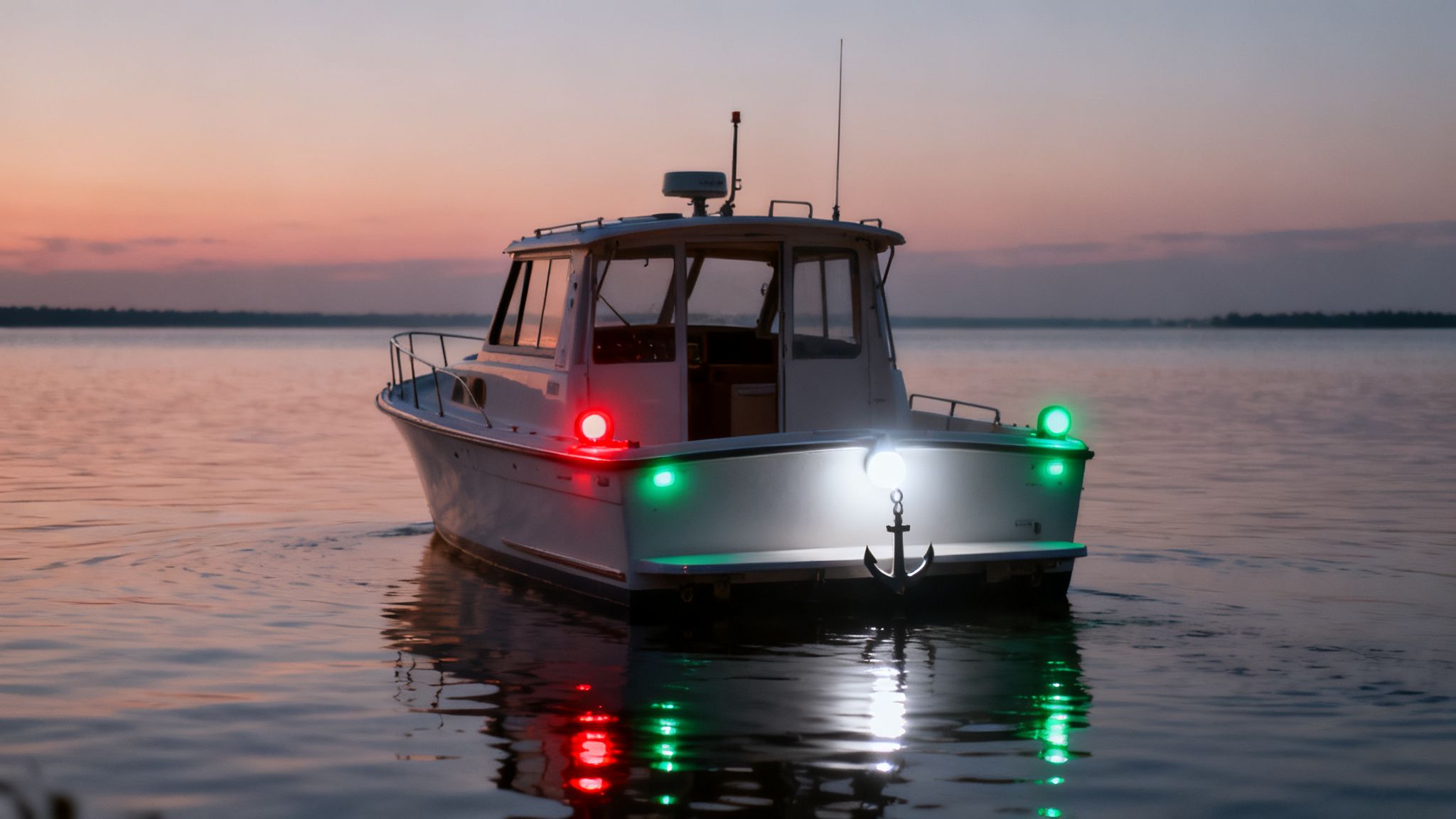
Think of your navigation lights like the traffic signals of the waterways. Just like headlights and turn signals on a car, the color, placement, and visibility of your boat's lights instantly tell other captains what you're up to. Are you a powerboat on the move? A sailboat under sail? Or are you just anchored for the night? Your lights answer these questions at a glance, cutting through confusion and preventing accidents.
These rules are enforced by the U.S. Coast Guard and are based on a set of international standards called the COLREGs (International Regulations for Preventing Collisions at Sea). They form a universal language that boaters all over the world understand. Not following them can lead to fines, major liability if an accident happens, and most importantly, puts you and your passengers in serious danger.
Why Every Boater Must Know the Rules
At its core, this is all about one thing: collision avoidance. At night or in a downpour, your ability to see other vessels drops to almost nothing. A properly lit boat can be spotted from miles away, which gives everyone enough time to react and steer clear.
The requirements are designed to communicate key information instantly:
- Your Boat's Status: Are you underway, at anchor, or doing something specific like towing?
- Your Direction of Travel: The combination of red, green, and white lights shows other boats which way you're headed.
- Your Vessel Type: The light configuration helps others tell the difference between a powerboat and a sailboat.
Getting these fundamentals down is the first step toward becoming a responsible boater. And these rules aren't just for huge commercial ships—they apply to every single vessel, from a tiny fishing boat to a massive yacht. You can learn more about overall vessel compliance by reading our complete guide on boat safety requirements.
The COLREGs are more than a set of rules; they are a system of communication designed to work flawlessly in the most challenging conditions, ensuring that every boater can understand the actions and intentions of others on the water.
A Quick Guide for Recreational Boats
For most recreational boaters, the rules are thankfully pretty straightforward and are based on the length of your boat. Here’s a quick look at the most common setup for power-driven vessels under 39.4 feet (12 meters).
Quick Reference Guide for Recreational Boats Under 39 Feet
| Light Type | Color | Arc of Visibility | Minimum Range |
|---|---|---|---|
| Masthead Light | White | 225 degrees (forward) | 2 nautical miles |
| Sidelights | Red (Port), Green (Starboard) | 112.5 degrees (each side) | 1 nautical mile |
| Sternlight | White | 135 degrees (aft) | 2 nautical miles |
| All-Round Light | White | 360 degrees (replaces Masthead/Sternlight) | 2 nautical miles |
Making sure your lights meet these standards is non-negotiable for safe boating after dark. That’s why at Better Boat, we design fully compliant navigation lights and safety gear. We want to make it simple to meet these legal requirements so you can focus on enjoying your time on the water with complete peace of mind.
Why Maritime Lighting Rules Exist
Today’s boat navigation light rules didn't just appear out of thin air. They’re the hard-won result of centuries of maritime accidents, with each tragedy teaching a painful lesson about the dangers of running dark on the water. The move from simple, random lanterns to a universal lighting system is a story of life-saving innovation.
When you understand the history, you realize these regulations are much more than just a bureaucratic checklist. They’re a shared language on the water, allowing boaters to communicate their position, status, and intentions with absolute clarity. It's a language born from disaster, refined over generations, and designed so that history doesn't repeat itself.
From Chaos to Clarity
Imagine driving at night on a highway where every car had different colored headlights—or none at all. For centuries, that was the reality on the water. Early mariners used simple lanterns, but with zero standardization, a single light could mean anything from a small fishing boat to a massive steamship. This chaos led to constant confusion and deadly collisions.
The first real steps toward a unified system came in the 19th century as sea traffic exploded. In 1848, the British Admiralty mandated red and green sidelights for their steam vessels, a foundational concept that’s still with us today. This simple color-coding system—red for port, green for starboard—was one of the first successful attempts to create a predictable visual language for all mariners.
These rules are not just about compliance; they are a fundamental part of seamanship. They transform a boat's lights from simple bulbs into a clear voice that speaks a universal language of safety, direction, and intent across any body of of water.
The Evolution of Global Standards
The United States actually took a pioneering step in boat safety back in 1838, passing an act that required steamboats to carry one or more signal lights after dark. This early momentum eventually led to the first International Maritime Conference in Washington in 1889, which created rules adding a second masthead light for steamships.
Further tweaks in 1948 adjusted these requirements, finally culminating in the 1972 International Regulations for Preventing Collisions at Sea (COLREGs), which standardized navigation light rules for the entire world.
These globally recognized standards are the bedrock of modern maritime safety. They ensure a boater in Florida instantly understands the lights of a vessel from Japan. By following these rules, you’re taking part in a tradition of safety that has saved countless lives. It’s a core responsibility for anyone who takes the helm and a critical part of safe boating at night.
Thankfully, modern technology makes upholding this tradition easier than ever. Upgrading to bright, reliable LED lights is one of the simplest and most effective ways to ensure you are clearly seen and understood on the water. These modern solutions honor the hard-learned historical lessons by providing far superior visibility and reliability, keeping the life-saving language of light clear and strong for the next generation of boaters.
Decoding Your Boat's Specific Light Configuration
Think of your boat's lights like a car's turn signals and headlights. They’re a simple, visual language that tells every other boater on the water exactly where you are and what you’re doing. Knowing what your own lights are saying is the first step to staying safe after dark.
For other boaters, your lights paint a clear picture. The combination of red, green, and white lights instantly signals your boat's size, its direction, and whether you're moving or stopped. Getting this configuration right is the most fundamental part of meeting boat navigation light requirements.
The Core Components of Navigation Lighting
Most recreational powerboats are kitted out with a standard set of lights, and each one has a specific job to do. Together, they create a full 360-degree profile of your vessel.
- Sidelights: These are your red and green lights. The red (port) light is always on the left side, and the green (starboard) is on the right. Each one shines in an unbroken arc of 112.5 degrees, from straight ahead to a point just behind the middle of the boat.
- Masthead Light: This is a white light facing forward, positioned along the boat’s centerline. It shines across a 225-degree arc, perfectly covering the area not lit by the two sidelights from the front.
- Sternlight: This is another white light, but it's positioned at the rear (stern) of the boat. It shines backward in a 135-degree arc. When you add it up, the masthead and sternlight arcs equal 360 degrees, making your boat visible from every direction while underway.
This infographic shows how we got from simple lanterns to the universal, standardized system we use today.
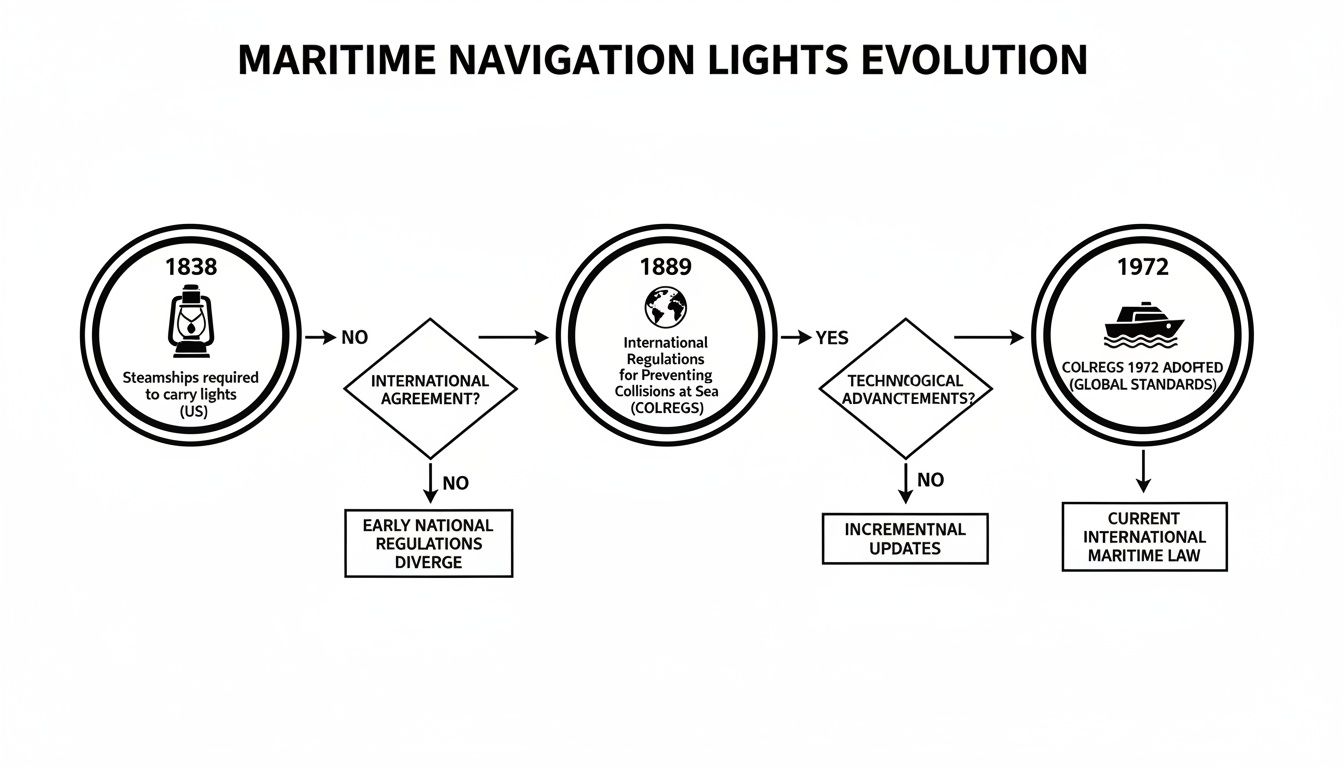
It’s been a long journey, but it was all driven by the need for a clear, collision-proof language on the water.
Special Configurations for Different Situations
The lights you show depend entirely on what your boat is doing. The standard "underway" setup for a powerboat is just one of several displays you'll need to know.
When your boat is at anchor, it sends a completely different signal. Instead of showing directional lights, you must display a single, all-round white light. This tells other vessels, "I'm not moving, so don't treat me like a boat that is."
This single anchor light must be visible from 360 degrees. You should always place it at the highest practical point on your boat to make sure everyone can see it from a distance.
Sailboats and Vessels Under Tow
Sailboats play by a slightly different set of rules. When moving under sail alone (engine off), they show the red and green sidelights plus a sternlight—but no masthead light. This is a crucial signal that tells other boaters the sailboat might not be able to maneuver as easily as a power-driven vessel.
The moment a sailboat's engine kicks on, however, it's legally considered a power-driven vessel. That means it must switch over to the standard powerboat configuration: sidelights, a masthead light, and a sternlight. Understanding all your safety responsibilities is key, which is why we’ve detailed more in our guide to boat safety gear requirements.
Boats that are towing another vessel have even more complex rules, often requiring extra yellow lights to signal what they're doing. For most of us on the water, the main job is simply to recognize these different patterns to understand what’s happening around us.
Meeting Critical Visibility and Certification Standards
Just strapping any old light to your boat won't cut it. Your navigation lights have to meet some pretty specific, non-negotiable standards for brightness, durability, and even the exact shade of their color.
Think of it like your car’s headlights—a dim, flickering bulb isn't just useless, it's dangerously misleading to other drivers. Your boat's lights need to be powerful enough to be seen from a set distance, measured in nautical miles, giving other vessels plenty of time to see you and react.
This isn't a one-size-fits-all rule, either. The required visibility range scales right along with the size of your boat. A small runabout might only need its sidelights to be seen from one nautical mile out, but a larger yacht’s lights have to slice through the darkness for two or even three nautical miles. This system makes perfect sense; it ensures the bigger, less nimble boats are spotted much earlier on the horizon.
The Importance of USCG Certification
So, how do you know if a light is up to snuff? Look for the U.S. Coast Guard (USCG) certification. This is your guarantee that a light has been put through the wringer—rigorously tested for brightness, true color, and the ability to stand up to the wet, salty marine world. A USCG-certified light is proven to work when you need it most.
Using non-certified lights is a huge gamble. They might look the part, but there's no promise they’ll meet the strict visibility ranges or show the right color. During a routine safety check or, worse, an emergency, that uncertified gear could get you a fine and, more importantly, lead to a disastrous miscommunication on the water.
Certification is the bedrock of maritime safety. It removes guesswork and ensures that every light on the water speaks the same, clear language of visibility and intent, upholding a system designed to prevent collisions and save lives.
Understanding Visibility Requirements by Boat Size
The rules of the road on the water, officially known as the International Regulations for Preventing Collisions at Sea (COLREGs), lay out clear minimums that the U.S. Coast Guard follows.
- Boats Under 39 feet (12 meters): Sidelights must be visible for at least 1 nautical mile. The all-round white light needs a 2-nautical-mile range.
- Boats Between 39 and 65 feet: The minimums jump up. Sidelights and sternlights need a 2-nautical-mile range, and the masthead light needs to be seen from 3 nautical miles away.
Here’s a wake-up call: a 2010 study found that many factory-installed lights, especially older incandescent models, actually failed to meet their own stated visibility distances in real-world tests. This points to a serious safety gap many boaters are completely unaware of. You can learn more about these important findings on boat light performance to see just how critical this is.
Following these visibility and certification rules isn't just about avoiding tickets; it’s also a key factor for practical things like getting and keeping valid snorkel dive boat insurance.
Why Upgrading Is a Smart Investment
This is exactly why swapping out old lights for modern, certified ones is more than just a simple upgrade—it's a direct investment in your safety. Outdated or non-compliant lights create a risk that just isn't worth taking.
Putting your money into high-quality, reliable options like Better Boat’s certified LED navigation lights ensures your boat doesn't just meet the rules but actually exceeds them. LEDs are the clear winner for any safety-conscious boater, offering way better brightness, a much longer lifespan, and superior durability.
When you choose certified lights, you’re not just following the law; you’re making sure you are seen, safe, and secure every single time you leave the dock.
How to Choose and Maintain Your Navigation Lights
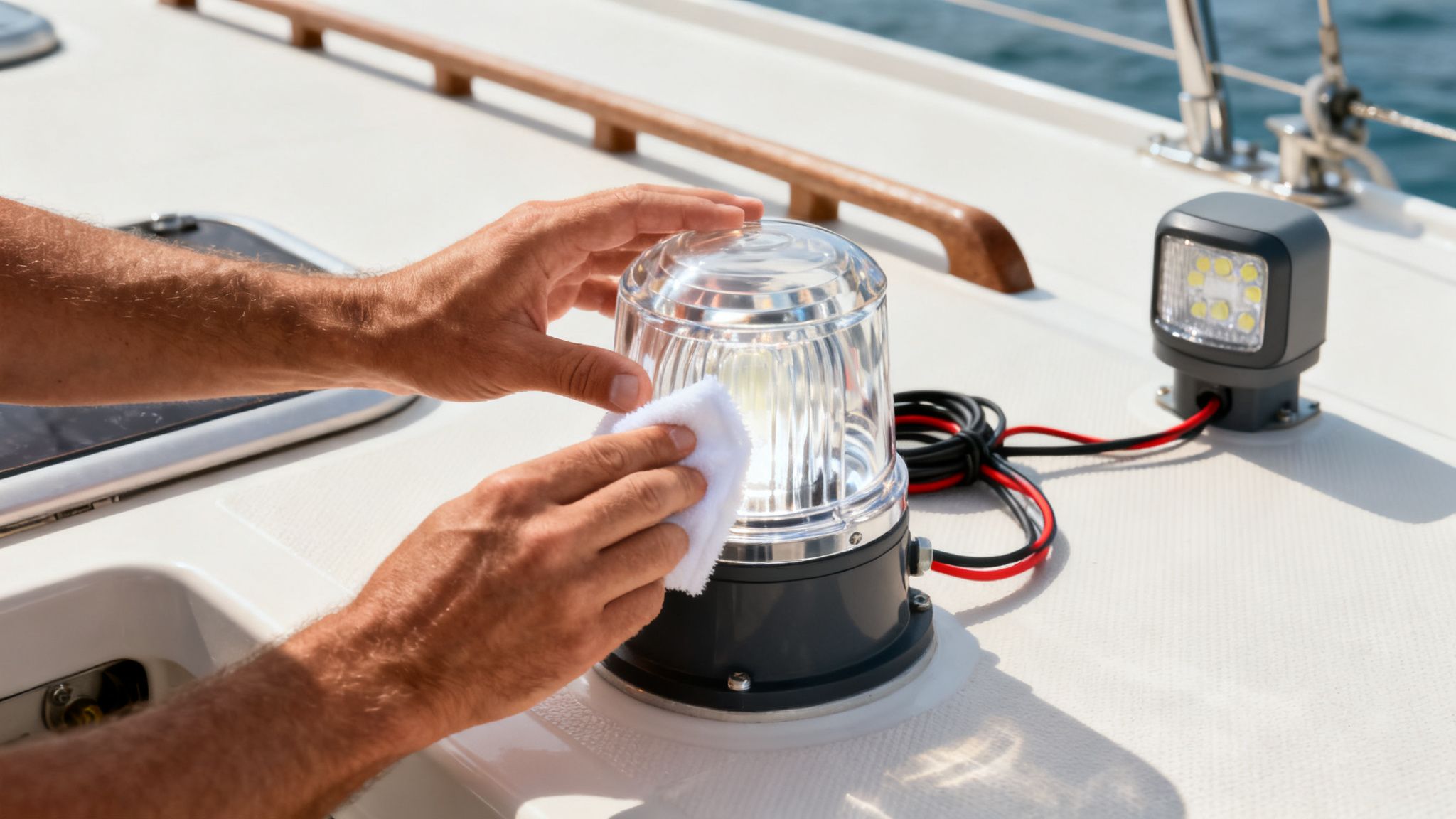
Knowing the rules of the road is one thing, but choosing the right navigation lights and keeping them in prime condition is where the rubber really meets the road. This is practical boat ownership, plain and simple. Think of your lights as one of the most critical pieces of safety gear you own—selecting durable, bright, and reliable ones is a direct investment in your peace of mind out on the water.
Proper maintenance isn't a chore; it's what ensures those lights work flawlessly every single time, especially when the weather turns on a dime. A simple routine can make all the difference.
The Clear Advantages of Upgrading to LED
If you're in the market for new lights, the debate between older styles and modern tech is pretty much over. While you can still find traditional bulbs, understanding the difference between Halogen vs LED lights makes the decision easy. For any modern boater, the choice is crystal clear: Light Emitting Diodes (LEDs) beat old-school incandescent bulbs in every way that matters.
- Superior Brightness and Clarity: LEDs punch out a much brighter, crisper light. This makes your boat easier to spot from farther away and ensures your red and green lights are vivid and unmistakable.
- Incredible Longevity: An old incandescent bulb might give you 1,000 hours if you're lucky. A quality marine LED? We're talking 50,000 hours or more. That means less time on the deck changing bulbs and more time enjoying the water.
- Massive Energy Savings: This is a huge one. LEDs sip power, using just a fraction of the energy that incandescent bulbs guzzle. That means less strain on your battery and electrical system, which is a major win when you're running other electronics.
- Extreme Durability: Incandescent bulbs have a fragile little filament that hates vibration. LEDs are solid-state, making them incredibly resistant to the shock and pounding that every boat experiences.
This isn't just a trend; it's a fundamental shift in maritime safety. The boat lights market is expected to hit $1,357 million by 2035, growing at a 7.5% annual clip. That growth is pushed by tougher regulations and boaters everywhere switching to superior LED technology.
Your Essential Maintenance and Installation Checklist
Even the best lights on the market are useless with a dirty lens or a corroded wire. A perfectly certified light can be rendered completely ineffective by poor upkeep. Stick to this simple checklist to keep your entire lighting system in fighting shape.
- Test Before Every Trip: This is non-negotiable. Before you even think about casting off lines, especially if you might be out after sundown, flip the switch. Do a quick walk-around and put eyes on every single light to make sure it’s working.
- Keep Lenses Crystal Clear: A film of salt spray, dirt, or grime can gut your light's visibility. Get in the habit of wiping down the lenses with a soft cloth and a gentle cleaner. Maximum brightness depends on a clean lens.
- Inspect for Corrosion and Damage: The marine environment is brutal. Routinely check the light housings for cracks and give the wiring and connections a close look. Any green or white crusty buildup on the terminals is a major red flag that needs to be addressed immediately.
- Ensure Secure, Watertight Connections: A solid installation is everything. Shoddy wiring and loose connections are the top causes of flickering lights or outright failure. Always use marine-grade wiring and quality heat-shrink wire connectors to create a waterproof seal that locks out moisture. You can dive deeper into setting up your boat’s systems in our complete guide to boat electronics.
A perfectly compliant navigation light is only as reliable as its weakest link. Consistent maintenance and professional-grade installation aren't optional—they are the foundation of a safe and dependable lighting system.

By upgrading to modern LEDs and sticking to a straightforward maintenance routine, you’re making sure your boat can always communicate its position and intentions clearly. You’ll meet all boat navigation light requirements and, more importantly, keep everyone aboard safe.
Common Questions About Boat Navigation Lights
Even when you feel like you have a good handle on the rules, certain situations on the water can still leave you scratching your head. Let's clear the fog and tackle some of the most common questions boaters have about navigation lights.
Do I Really Need Navigation Lights During the Day?
Not usually. The law says you need to display your navigation lights from sunset to sunrise. This is when lights become the primary way boats "talk" to each other and avoid collisions.
That said, the rules also require lights during any period of restricted visibility. This isn't just about nighttime. If you get caught in dense fog, a sudden downpour, or even heavy smoke during the day, you need to flip those lights on. It’s a great habit to quickly test your lights before every single trip, just in case conditions take an unexpected turn for the worse.
What Is the Difference Between a Masthead and an All-Round Light?
This is a great question, and the answer comes down to one thing: the arc of visibility. The different arcs tell other boaters what your vessel is doing.
- An all-round light is exactly what it sounds like—a white light that shines in an unbroken, 360-degree circle. It's used to show that a vessel is at anchor. On smaller powerboats (under 39.4 feet), it can also pull double duty as both the masthead and stern light when underway.
- A masthead light is a white light that shines forward over a 225-degree arc. It's only used by powerboats when they're moving and must be paired with a separate 135-degree sternlight to achieve that full 360-degree coverage.
Think of it this way: an all-round light says, "I'm here, but I'm not going anywhere." The masthead and sternlight combination says, "I'm a powerboat, and I'm on the move."
Are Lights Required for Kayaks and Other Small Boats?
Yes, but the rules are much more practical for smaller, unpowered boats. The law understands you can't exactly wire up a full lighting system on a canoe.
For unpowered vessels like kayaks, canoes, and rowboats, you don't need fixed lights. Instead, you must have an electric flashlight or a lighted lantern showing a white light, ready to be displayed in enough time to prevent a collision.
Sailboats under 23 feet also have another simple option when sailing. They can use a single tricolor light at the top of the mast, which combines the red sidelight, green sidelight, and white sternlight into one convenient fixture.
Can I Use Blue or Colored LED Accent Lights?
This is where you have to be extremely careful. While adding stylish accent lights is popular, it can create major safety hazards and get you in legal trouble if you're not careful.
Blue lights, especially flashing ones, are almost always reserved for law enforcement and emergency vessels. Using them on your recreational boat is illegal and can lead to some hefty fines. Any cool decorative lighting you install must never:
- Block or overpower your required navigation lights.
- Be mistaken for a navigation light (like putting blue LEDs right next to your red and green sidelights).
- Be so bright that it ruins your night vision or the night vision of other boaters.
Before installing any accent lights, always double-check your local and state boating laws to make sure you stay on the right side of the rules.
At Better Boat, we know that being safe and compliant is the key to enjoying your time on the water. As a family-owned American company, we're committed to offering top-tier, dependable boating products—from USCG-compliant LED lights to all the cleaning and maintenance gear you need. We're here to help you protect your investment and boat with total confidence. Check out our complete line of boating solutions at https://www.betterboat.com.