


Your Ultimate Boat Fender Size Guide
The quickest way to get a fender that works is to lean on a simple rule of thumb: for every 4-5 feet of boat length, you'll want one inch of fender diameter. This applies to the classic cylindrical fenders you see everywhere.
So, if you have a 25-foot boat, you'd be looking for fenders that are at least 5-6 inches across. It's a straightforward calculation that gives you an excellent starting point for protecting your pride and joy.
Quick answer: boat fender size chart
For most recreational boats, start with one inch of cylindrical fender diameter for every four to five feet of boat length, then size up for heavy boats, rough slips, high docks, rafting, or tidal swings. Use enough fenders to protect the widest contact points and rig them with dedicated fender lines so height adjustments are fast.
Fast fender setup match
Picking up a pair of cylindrical fenders sized to that formula is the fastest way to put the rule into practice.

Protect your hull right
Boat Fenders
Correctly sized cylindrical fenders are the foundation of any solid docking setup. Keep a pair on board so you always have the right protection at the widest contact points.
| Boat or docking need | Practical choice | Better Boat path |
|---|---|---|
| Small to midsize hull protection | Use correctly sized cylindrical fenders and inspect inflation often. | Boat Fenders |
| Quick height adjustment | Use dedicated fender lines instead of stealing dock lines from mooring duty. | Fender Lines |
| Dirty or mildew-spotted fenders | Clean fenders before grime transfers to gelcoat or vinyl. | Mildew Stain Remover for mildew spots |
| Rough marina, rafting, or heavy traffic | Go one size up and add extra coverage at the beam, bow, or stern. | Use the size chart below as the baseline, then adjust for conditions. |
Boat Fender Size Chart
| Boat Length | Cylindrical Fender Diameter | Round Fender Diameter | Minimum Fenders |
|---|---|---|---|
| Under 20 ft | 4 in | 9 in | 3 |
| 20 to 25 ft | 5 to 6 in | 11 in | 3 |
| 25 to 35 ft | 6 to 8 in | 15 in | 4 |
| 35 to 45 ft | 8 to 10 in | 18 in | 4 to 6 |
| 45 to 60 ft | 10 to 12 in | 21 in | 6 |
A good rule of thumb: about 1 inch of cylindrical fender diameter for every 4 to 5 feet of boat length, with at least three fenders aboard and roughly one fender for every 10 feet of waterline.
Why the Right Fender Size Is Your First Line of Defense
Picking the right fender size isn't just about grabbing something off the shelf, it's probably the most important call you'll make to protect your boat's hull from ugly and expensive damage. Think of your fenders as personal airbags for your boat, perfectly sized to soak up the impact from docks, pilings, or even another boat.
Without the right cushioning, even a gentle nudge from a wake or a slight current can leave you with frustrating scratches, deep gouges, or worse.
Getting this right means you can approach the dock with confidence, knowing your vessel has the protection it needs. A fender that's too small is almost useless; it will just collapse under pressure and won't do a thing to keep your hull off a hard surface.
On the other hand, one that's way too big is a pain to handle and store, and it might not even hang correctly against the hull to do its job effectively.
The Standard Rule of Thumb
In the boating world, we rely on a simple formula to figure out the minimum fender diameter you need based on your boat's length. This standard is a reliable baseline for most recreational boats in typical docking situations.
Sure, other factors like your boat's weight and where you're docking will come into play, but starting with this rule ensures your boat is never left vulnerable.
This decision tree gives you a quick visual on how it all works, showing the direct link between your boat's length and the fender diameter you should be looking for.
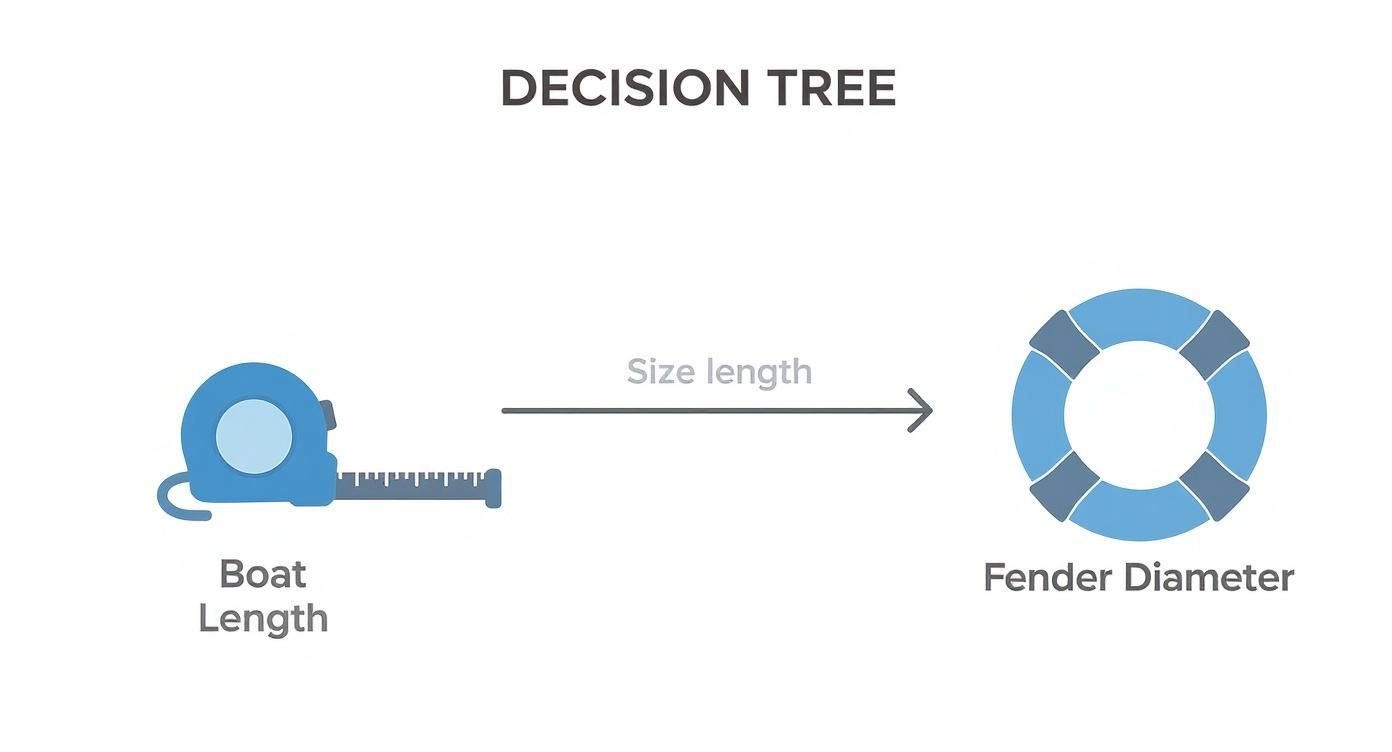
As you can see, the logic is clear: a longer boat needs a beefier fender with a larger diameter to provide enough of a cushion.
For a fast, reliable recommendation on cylindrical fender diameter based on your boat's length, this table is your best friend.
Quick Reference Boat Fender Sizing Chart
| Boat Length (Feet) | Boat Length (Meters) | Recommended Fender Diameter (Inches) | Recommended Fender Diameter (mm) |
|---|---|---|---|
| Up to 10' | Up to 3m | 3" | 76 mm |
| 10' - 20' | 3m - 6m | 4" | 102 mm |
| 20' - 25' | 6m - 7.5m | 5" | 127 mm |
| 25' - 30' | 7.5m - 9m | 6" | 152 mm |
| 30' - 35' | 9m - 10.5m | 8" | 203 mm |
| 35' - 50' | 10.5m - 15m | 10" | 254 mm |
| 50' - 60' | 15m - 18m | 12" | 305 mm |
This chart simplifies the process, but remember to consider your specific docking conditions, if you're in a rough or high-traffic area, it's always smart to go one size up.
A More Precise Calculation
For those who prefer to work with metric units, there's another widely accepted standard. This approach suggests that the diameter of a cylindrical fender should be about 2.5 cm for every 1.2 meters of a boat’s length.
Take a 15-meter yacht, for example. The math would point to a fender with a diameter of about 31.25 cm, which you'd round up to the next available size. If you're dealing with a smaller boat under 6 meters, 100 mm diameter fenders are usually plenty. You can find more insights on this fender sizing method and how it works for different boat lengths.
Key Takeaway: No matter how you calculate it, the goal is to create a protective barrier that’s proportional to your boat's size and the kind of forces it might encounter. Starting with the length-to-diameter rule is the smartest first step in any good boat fender size guide because it gives you an immediate, practical answer to keep your boat safe.
Decoding the Core Fender Sizing Factors
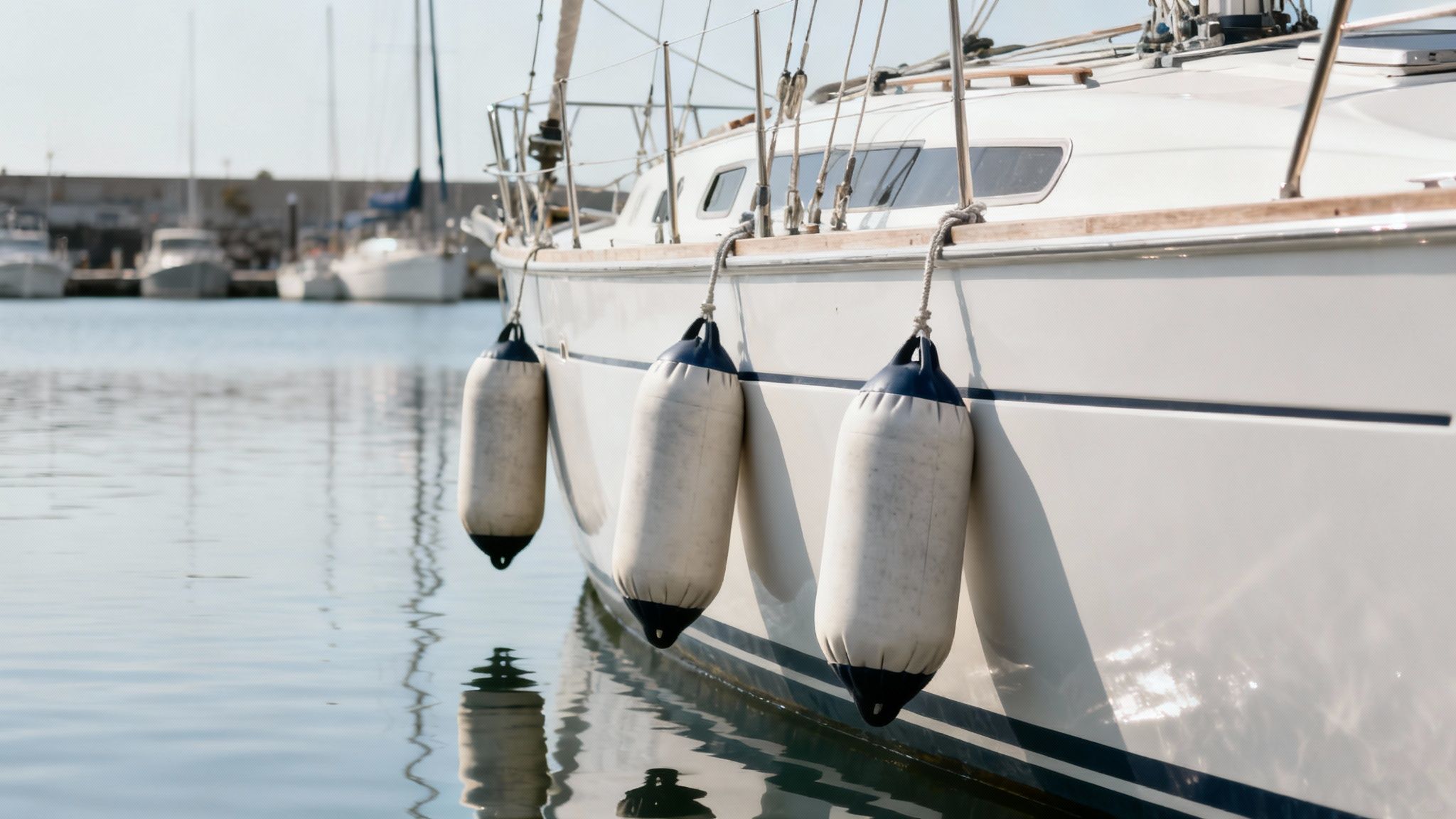
While your boat’s length is a great starting point for picking out fenders, it's really just one piece of the puzzle. To build a defense system that actually works, you need to look at three other critical factors: your boat’s weight, its beam, and the kinds of places you usually dock.
Think of it like choosing the right suspension for a truck. A little pickup doesn't need the same heavy-duty shocks as a fully loaded semi-trailer. In the same way, a lightweight runabout and a heavy cruiser of the exact same length need completely different levels of protection. Ignoring these details is like showing up for a hurricane with a beach umbrella, you'll quickly realize your gear just isn't up to the task.
The Impact of Boat Weight
The single biggest factor after length is your boat’s displacement, which is just a technical term for its total weight. Basic physics tells us that heavier objects carry a lot more momentum. When a heavy boat drifts toward a dock, even at a snail's pace, it generates a massive amount of force that something has to absorb.
Picture trying to stop two rolling balls of the same size. One is a hollow plastic toy, and the other is a solid bowling ball. You already know which one is going to take more effort, and a much bigger cushion, to stop safely. Your boat works the exact same way.
A fender that’s perfectly adequate for a 25-foot, 5,000-pound bowrider will get completely flattened by a 25-foot, 10,000-pound cabin cruiser. The heavier boat will simply crush that undersized fender and transfer all that impact energy right into your hull. That’s precisely why our lineup of heavy-duty fenders is built to handle the extra forces from heavier vessels, giving you the robust cushioning needed to protect your investment.
Pro Tip: Always look up your boat's displacement weight in the specs, don't just go by length. If you have a heavier-than-average boat for its size, like a sportfisher or trawler, it's always a smart move to go one size up from what the length chart suggests.
Why Your Boat's Beam Matters
Next up is your boat’s beam, its width at the widest point. A wider beam creates more leverage against a dock or piling. As your boat rocks and rolls with waves or passing wake, that wide hull can exert a surprising amount of pressure on your fenders.
This extra surface area and leverage call for fenders that can take the pressure without collapsing. A fender that's too skinny for a wide-beamed boat might just get pushed out of the way, letting the hull smack right into the dock. This is especially true for boats with a big flare at the bow, which can easily ride up and over a fender that isn't sized correctly.
- Increased Leverage: A wider beam acts like a longer lever, multiplying the force pushed against the dock as the boat rolls.
- Greater Surface Contact: Wider boats have more hull to protect, often needing not just bigger fenders, but more of them.
- Stability Challenges: The way a wide boat settles against a dock can create unique stress points that your fender setup needs to handle.
This is where having strong, dependable fender lines is just as important as the fender itself. Our premium fender lines help you secure your fenders tightly, keeping them right where they need to be to handle the forces from a wide beam. They’re designed to resist stretching and abrasion, giving you a secure hold in any weather.

Adapting to Docking Conditions
Finally, where you dock plays a huge role. The calm, predictable environment of a private slip in a protected marina is a completely different world from tying up to an exposed pier on a busy channel.
A boater on a quiet lake might get away with standard-sized fenders just fine. But if you’re docking in a tidal area with strong currents and constant boat traffic, you're going to need a much beefier setup. The rougher the water, the more your boat will move, and the harder your fenders will have to work.
Think about your typical docking spots:
- Protected Marinas: Standard fender sizes are usually enough here since wave action is minimal.
- High-Traffic Areas: Constant wakes from passing boats mean nonstop impacts, requiring larger and more durable fenders.
- Tidal Zones: Changing water levels mean you need longer fenders or have to be ready to adjust them so they don't end up above or below the dock.
- Rough, Unprotected Docks: Old concrete pilings or rough wooden piers demand the toughest, most substantial fenders you can get.
By thinking through your boat's weight, beam, and your usual docking conditions, you can get way beyond a one-size-fits-all approach. This gives you the insight to build a complete fender system that offers real protection, no matter where your adventures take you.
How Many Fenders Do I Actually Need?
Just like fender size, getting the number of fenders right is a huge deal. Think of it as setting up a defensive line for your boat, one or two players can't possibly cover the whole field. The same logic applies here. Skimping on fenders leaves your hull exposed, practically inviting scuffs, scrapes, and expensive damage.
The old industry rule of thumb is a good place to start: plan for at least one fender for every 10 feet of your boat's waterline length. This is the bare-bones minimum for most calm, everyday docking situations.
So, for a 30-foot boat, you're looking at three fenders. A 50-footer needs at least five. But please, hear me when I say this is just the minimum. Real peace of mind comes from having a couple of extras ready to go.
Why More Is Almost Always Better
Sticking to the minimum is probably fine on a perfect, windless day at your home slip. But let's be honest, how often is boating perfectly controlled? Seasoned boaters know that an extra fender or two can be the difference between a smooth, stress-free docking and one that has you holding your breath.
Think about these common situations where having more than the minimum is non-negotiable:
- Rafting Up: When you tie up alongside another boat, you'll want to double your fender count. You're not just protecting your hull anymore; you're protecting theirs, too.
- Rough Conditions: Wind and wake will have your boat bouncing around. Extra fenders are essential to absorb those constant impacts and prevent damage.
- Navigating Locks: Those rough, unforgiving concrete walls can do a real number on a hull. You’ll want plenty of extra cushioning, especially bigger fenders, to handle the scraping and shifting as water levels change.
Key Insight: Treat the "one per 10 feet" rule as your starting point, not your limit. An extra fender stowed away is one of the cheapest and most effective insurance policies you can have for your boat.
It's no secret that our waterways are getting busier. With over 15 million registered boats in the U.S. and another 6 million in Europe, docks are crowded. It's no wonder the global boat fender market, currently valued at $542 million, is expected to jump to $894 million by 2033.
Most of these boats fall into the 6-to-12-meter range, the sweet spot where proper fendering is absolutely critical. You can learn more about these market trends and what they mean for boaters.
Where to Actually Place Your Fenders
Having enough fenders is only half the battle. Knowing where to hang them is what really counts. The goal is simple: put them at the key points of contact between your boat and the dock (or another boat).
For docking alongside a pier, a classic three-fender setup is your best bet for even pressure distribution.
- At the Widest Point (Amidships): Start by placing one fender at your boat's beam, its widest point. This is where you'll get the most contact.
- Fore and Aft: Next, hang one fender forward of the beam and another one aft of it. This creates a solid, balanced three-point protection system.
- Fill in the Gaps: If you have a longer boat, use your extra fenders to fill in the spaces between these three primary ones. You want to make sure no large section of your hull is left unprotected.
Nailing your fender placement is a huge part of docking like a pro. For more tips on maneuvering your vessel into a slip safely, check out our comprehensive guide on how to dock a boat.
Going the Extra Mile With a Fender Board
For the ultimate protection, especially against nasty pilings or rough seawalls, a fender board is an incredible tool. It's really just a sturdy plank of wood that you hang horizontally on the outside of your fenders.
The board takes the pressure and distributes it evenly across two or more fenders, creating a smooth, solid barrier between your hull and the dock. It stops individual fenders from getting caught on pilings or slipping into gaps, giving you continuous protection over a wider area. This trick is a lifesaver in locks or when tying up to widely spaced pilings.
To make things easy, our complete fender kits give you everything you need in one shot. They come with perfectly matched fenders and high-quality fender lines, taking all the guesswork out of building a bulletproof defense for your vessel.
Selecting the Best Fender Type for Your Boat
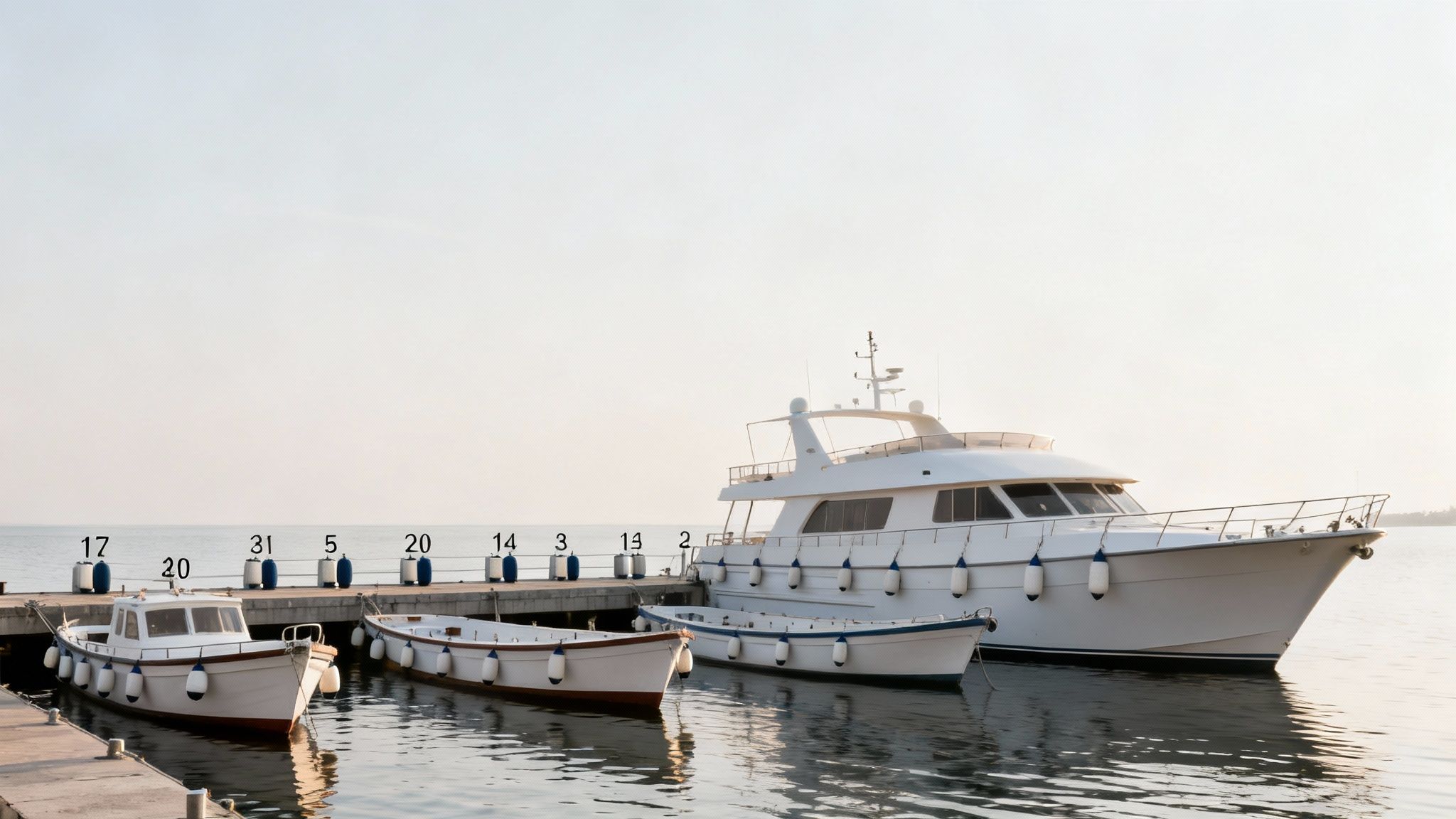
Once you've nailed down the right size and number of fenders, the next puzzle piece is choosing the right type. They aren't all created equal, and each style is built for a specific job.
Think of it like having a good toolbox, you wouldn't grab a screwdriver to hammer in a nail. In the same way, the fender that works perfectly in a standard marina slip might be a terrible choice for a boat with a dramatic, flared bow.
Picking the right type means matching the fender’s design to your boat's hull and where you typically tie up. This is what turns an adequate fender setup into an exceptional one, giving you real peace of mind.
Cylindrical Fenders: The All-Around Workhorse
When you picture a boat fender, you’re almost certainly thinking of a cylindrical fender. These are the most common and versatile option you'll see on the water, and for good reason. Their uniform shape is perfect for protecting the long, relatively flat sides of your hull when you're rafted up or tied alongside a dock.
They're simple to store, can be hung vertically or horizontally, and just plain work for the vast majority of recreational boats. In fact, cylindrical fenders are the go-to choice, with diameters ranging from 100 mm for small boats to 400 mm for larger vessels up to 18 meters. The global marine fender market was recently valued at around $771 million, showing just how essential these pieces of gear are.
Round Fenders: The Heavy-Duty Protector
Round fenders, often called ball fenders, are the heavy-duty specialists of the fender world. Their spherical shape provides a massive amount of cushioning and pushes your boat further away from the dock, making them ideal for tricky situations.
They really shine when you're dealing with:
- Boats with flared bows: A flared hull can easily push a standard cylindrical fender up and out of the way. A round fender's shape keeps it locked in place right where you need it.
- Commercial vessels and large yachts: These heavy boats generate a lot of force when they move. The superior impact absorption of a ball fender is a must.
- Rough waters: When waves are kicking up, you want that extra-large buffer zone between your hull and the dock.
Sure, they take up more storage space, but their unmatched protection in specific scenarios makes them non-negotiable for many boaters. For a deeper dive into how different fenders handle various docking challenges, you might want to check out our article on dock bumpers and fenders.
Specialty Fenders for Unique Challenges
Beyond the two main players, a whole world of specialty fenders exists to solve very specific problems. These clever designs show how a well-thought-out fender strategy can protect every inch of your boat. Understanding different boat handling techniques, like those taught in a PADI Boat Diver course, can help you better appreciate when these unique fenders are needed.
Key Takeaway: The best fender strategy often involves a mix of types. Using cylindrical fenders along the hull and a large round fender at the bow or stern gives you comprehensive protection that's perfectly tailored to your boat.
A few popular specialty fenders include:
- Transom Fenders: Designed to hug the stern of your boat, they’re lifesavers for protecting swim platforms during stern-to docking.
- Piling Fenders: These attach directly to dock pilings, creating a soft cushion that stays put no matter what the tide is doing.
- Flat Fenders: These are compact, easy to store, and fantastic for smaller boats or tight squeezes. Best of all, they won't roll or shift out of position.
By thinking through your boat's unique shape and your docking habits, you can build a customized defense system. Matching the right fender type to the right job is the final piece of the puzzle for total confidence at the dock.
Mastering Fender Height and Placement
Having the perfect size and number of fenders is a great start, but it's all for nothing if they aren't positioned correctly. A fender hanging too high or too low is like a bodyguard standing in the wrong room, completely useless when trouble arrives. Nailing the height and placement is the final, critical step in turning your fenders into an effective, damage-proof shield for your hull.
The whole point is to position each fender so it provides maximum cushion right at the point of contact. This sweet spot changes depending on the dock, the tide, and even how your boat is tied. Getting it right is a skill that separates novice boaters from seasoned captains, and trust me, it’s easier to learn than you might think.
Setting the Perfect Fender Height
Here's the golden rule for fender height: the bottom of the fender should hang just an inch or two above the waterline. This simple trick aligns the thickest part of the fender with the widest part of your boat’s hull, which is exactly where it’s most likely to bump a standard dock.
Hanging it too high is a rookie mistake. As your boat rocks, the fender can easily pop up and over the dock, leaving your hull completely exposed to a nasty scrape. On the flip side, hanging it too low is just as bad. A low-hanging fender can get shoved underneath the dock, offering zero protection and potentially getting damaged or lost for good.
Pro Tip: Always adjust your fender height for the specific dock you're approaching. A high pier requires a totally different setup than a low-floating dock. Make your adjustments before you make your final approach for a smooth, stress-free docking.
Adapting to Different Docking Environments
Your docking environment really dictates your strategy. A calm, predictable slip is one thing, but dealing with fixed pilings or big tidal swings requires a more thoughtful approach.
- Floating Docks: These are the easiest to handle. Since they rise and fall with the water level, you can usually "set and forget" your fender height once you're tied up.
- Fixed Docks and Pilings: This is where you need to stay on your toes. In areas with significant tidal swings, you'll have to regularly adjust the height of your fenders. As the tide falls, lower them; as it rises, bring them back up to keep them perfectly positioned.
- Rafting with Other Boats: When tying up next to another vessel, hang your fenders so they are level with the other boat's rub rail. This is key to preventing hulls from grinding against each other and ensures both boats stay protected.
Tying On for Security: The Clove Hitch
A fender is only as secure as the knot holding it. The undisputed king of fender knots is the clove hitch. It's incredibly easy to tie, a cinch to adjust on the fly, and holds tight under load. Every single boater should have this knot in their back pocket.
A good clove hitch holds, but having dedicated fender lines on hand means you can dial in height fast without repurposing your dock lines.

Dedicated lines for the job
Fender Lines 2 Pk
Fender lines let you dial in height quickly without pulling dock lines off their mooring duty. A reliable pair keeps every fender exactly where you set it, even when wake or wind pushes the hull around.
Using strong, reliable lines is just as important. Investing in a set of high-quality, pre-spliced fender lines makes the entire process faster and way more secure. They're built to resist abrasion and UV damage, ensuring your expensive fenders stay attached to your boat, not floating away in the marina.
Vertical vs. Horizontal Placement
Most of the time, you'll hang your cylindrical fenders vertically. This is the standard orientation for tying up alongside a dock or another boat. It just works.
However, there are definitely times when hanging a fender horizontally is the smarter move. This trick is especially useful when you're tying up to a single piling. A horizontal fender can't slip off the side of the piling the way a vertical one can, giving you a much wider and more stable point of protection. To set it up, just run the line through the fender and tie off both ends.
Extending the Life of Your Boat Fenders
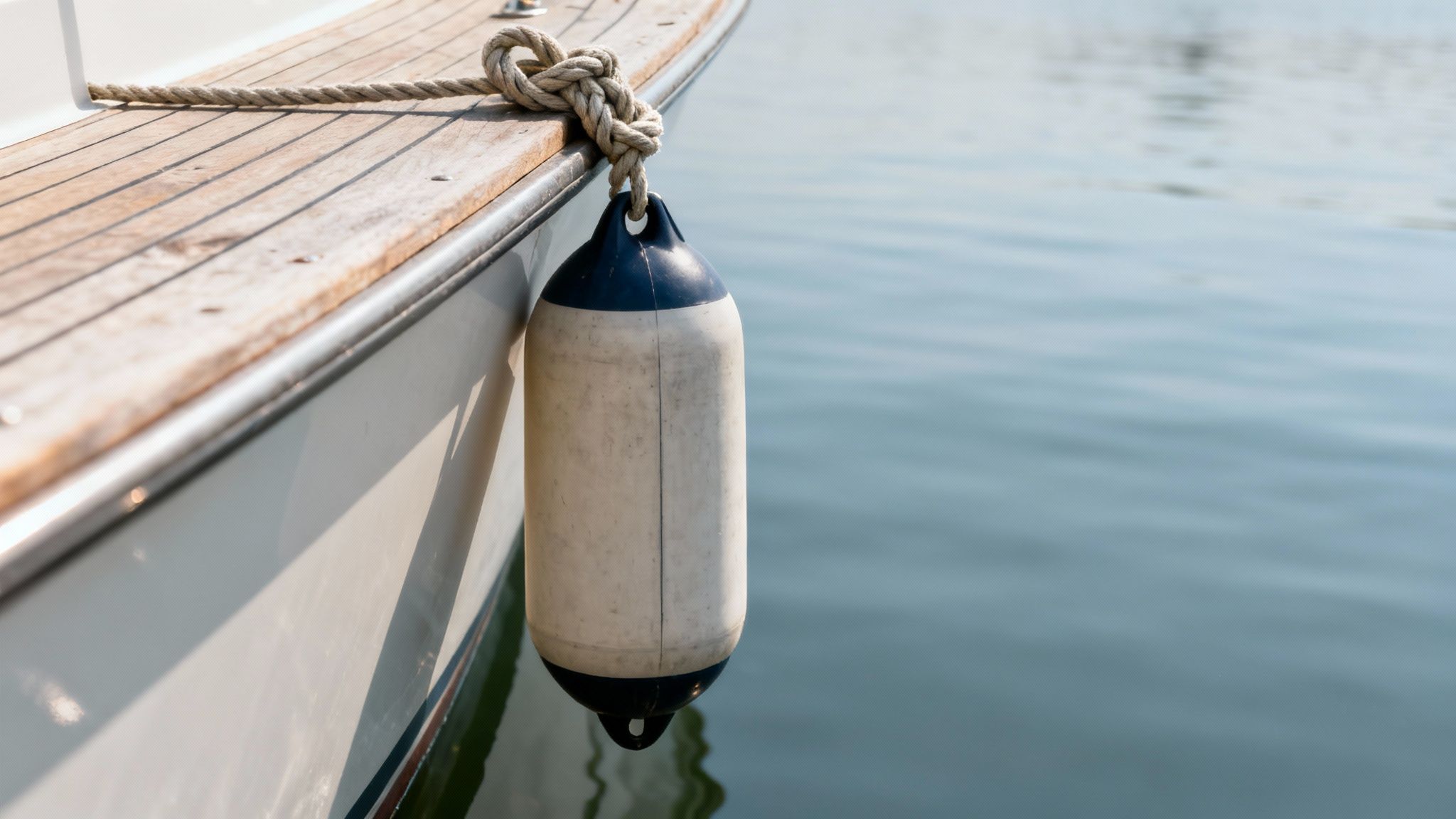
High-quality boat fenders are a serious investment in your boat's safety. Think of them as your hull's personal bodyguards. With the right care, they can protect your vessel for many seasons to come. Thankfully, proper maintenance is pretty straightforward, but you can't skip it if you want them to perform when it counts.
Just like the tires on your car, a fender’s inflation level is everything. An under-inflated fender is just a soft blob that can't absorb a real impact. On the flip side, an over-inflated one becomes hard as a rock and will just bounce off the dock, transferring all that shock right back into your hull. Neither is good.
Proper Inflation Pressure: Your fenders should be inflated to about 2 PSI. A quick and reliable field test is to press on the fender with your thumb, you should be able to indent it by about half an inch. That's the sweet spot: firm enough to protect, but with enough give to cushion the blow.
Keeping Your Fenders Clean and Protected
Over time, your fenders are going to get beat up. They'll collect scuffs, barnacles, and all sorts of grime from rubbing against docks and pilings. Regular cleaning isn't just about looks; it prevents all that abrasive gunk from scratching up your boat’s gelcoat.
For scrubbing barnacle residue and dock grime off rounded fender surfaces, a boat scrubbing glove gives you a lot more control than a handled brush.

Clean fenders, clean gelcoat
Ultimate Boat Scrubbing Glove
Scrubbing off barnacle residue and dock grime is faster and gentler with a dedicated scrubbing glove. Regular cleaning stops abrasive buildup from transferring scratches to your hull.
For everyday salt and dirt, a simple rinse with fresh water and a scrub-down with our All-Purpose Boat Cleaner will do the trick. It's tough on grime but won't degrade the fender's vinyl.
But in damp, marine environments, mildew is inevitable. Those ugly spots won't come off with regular soap.
- Mildew Removal: To tackle those stubborn black or green spots, you need something stronger. Our Mildew Stain Remover is made specifically to lift mildew stains without harming the fender's surface, bringing it back to its original color.
- Scuff Marks: Tough scuff marks from pilings or other boats often require a little more elbow grease. A good boat cleaner paired with a non-abrasive scrub brush can usually lift them right off without damaging the vinyl.
For a deeper dive, check out our guide on how to clean boat fenders for more step-by-step tricks.
Smart Storage to Prevent UV Damage
Believe it or not, one of the biggest threats to your fenders isn't the dock, it's the sun. Constant exposure to UV radiation is brutal on vinyl. It causes it to become brittle, faded, and eventually crack, which drastically shortens its lifespan.
When your fenders aren't on duty, get them out of the sun. The best practice is to stow them in a locker, lazarette, or down below. If you have to keep them on deck, fender covers are a great option, or at least store them in a dedicated rack that provides some shade. This one simple habit can add years to the life of your fenders, making sure they’re ready to protect your boat when you need them most.
Common Questions About Boat Fenders
Even after you've got a handle on the basics, a few specific questions always seem to pop up. Nailing down the answers to these is what separates a good fender setup from a great one. Let’s tackle those lingering doubts so you can feel completely confident every time you pull up to the dock.
We'll cover everything from whether you can go too big with your fenders to the perfect inflation pressure that keeps your boat safe.
Can I Use Fenders That Are Too Big for My Boat?
You can, but you probably shouldn't. While it's always better to err on the side of slightly oversized rather than undersized, going way too big creates its own set of problems. Giant fenders are a pain to handle and an even bigger headache to store, especially on smaller boats where space is at a premium.
Beyond the hassle factor, they can hang awkwardly against the hull and fail to protect the right spots. The goal is to find that sweet spot between bulletproof protection and day-to-day practicality. Stick to the recommended sizes, and you’ll get all the cushioning you need without the unnecessary bulk.
What Is the Correct Inflation Pressure for My Fenders?
This is a big one, because getting it wrong can do more harm than good. Proper inflation is absolutely critical. Most vinyl fenders are designed to work best at a surprisingly low pressure, typically around 2 PSI (pounds per square inch). If you over-inflate them, they become hard and bouncy, which means they'll transfer impact forces to your hull instead of absorbing them.
Here's a simple, field-tested way to check: Press your thumb firmly into the fender. You should be able to easily make an indent of about half an inch. That tells you it has enough give to cushion a hit but is still firm enough to keep your boat off the dock.
An under-inflated fender is just as useless. It will simply collapse under pressure, offering virtually no protection at all.
Should My Fenders Touch the Water When Hung?
This is a classic question, and the answer is no, not quite. Ideally, you want the bottom of the fender to hang just an inch or two above the waterline. This isn't random, it's strategic. This height places the thickest part of the fender right at your boat's beam (its widest point), which is exactly where it needs to be to fend off a standard-height dock.
- Hung Too High: A fender that's too high will ride up and over the dock as the boat rocks, leaving your beautiful gelcoat completely exposed.
- Hung Too Low: Go too low, and you're just asking for trouble. The fender can get sucked underneath the dock by waves, leaving you with zero protection and a good chance of losing the fender altogether.
Always take a minute to adjust your fender lines based on the specific dock you're tied to and the current tide.
How Often Should I Replace My Boat Fenders?
There's no hard-and-fast expiration date on a fender. A quality fender's lifespan comes down to how much action it sees, how much sun it gets, and how well you take care of it. Regular inspection is your best guide.
Be on the lookout for obvious signs of wear and tear:
- Cracks or brittle spots in the vinyl
- Serious fading and discoloration from UV damage
- An inability to hold air for more than a day or two
If you spot any of these issues, the fender’s ability to protect your boat is shot, and it's time for a replacement. A little TLC, like cleaning them regularly and storing them out of direct sunlight when you can, will make them last much, much longer.
At Better Boat, we're all about protecting your investment. From heavy-duty fenders and strong, reliable lines to specialized cleaners that keep all your gear in top shape season after season, we've got you covered. Equip your boat with the best and dock with total confidence. Explore our complete collection of boating essentials.


