


Teak Deck Restoration: A DIY Guide for a Perfect Finish
A lot of boat owners start teak deck restoration at the wrong moment. The deck looks gray, rough, and tired, so they assume the answer is cleaner, sandpaper, and a free weekend. Sometimes that works. Sometimes it just burns more money off a deck that's already near the end of its useful life.
That's the part too many guides skip. A teak deck can often be brought back to life, but not every deck should be. If you're staring at blackened seams, loose planks, thin wood around fasteners, or a surface that's already been sanded too many times, the smart move may be to stop before you start.
Assessing Your Deck Before You Begin
The first mistake I see is treating every gray deck like it has the same problem. Gray teak by itself isn't a verdict. It may be simple weathering. It may also be the surface warning you that the seams, bond, or remaining teak thickness are already compromised.

A practical inspection starts on your hands and knees. Look closely at seam lines, plank edges, old repairs, fastener areas, and any spot that stays wet. Press with your thumb. Tap with the handle of a tool. You're listening and feeling for movement, hollow spots, and edges that don't feel solid anymore.
What Can Still Be Restored
Some decks look awful and still clean up well. Good candidates usually have sound planks, seams that are mostly intact, and enough wood left to tolerate light correction.
A restorable deck often shows these signs:
- Surface weathering: The teak is gray, dirty, or stained, but the planks still feel solid.
- Localized seam issues: A few small sections of failed caulk can be cut out and repaired without chasing failures across the whole deck.
- Even wear: The surface is worn, but not scalloped, dished, or hollowed in traffic lanes.
- Dry but stable wood: The deck may be thirsty, but it isn't flexing or breaking down at the edges.
If you need a quick refresher on teak itself, Better Boat's guide to teak wood for boats gives a useful overview of why it ages the way it does in a marine environment.
When Restoration Turns Into a False Economy
A tired teak deck can fool you. You clean it, sand it, recaulk a few seams, and it looks acceptable for a while. Then another set of seams opens, another area gets thin, and you're back in repair mode again.
Practical rule: If the deck needs repeated sanding and repeated seam work just to stay serviceable, stop thinking only about this season and start thinking about lifecycle cost.
That's where the actual decision begins. A repair source notes that some owners remove a tired teak deck entirely and replace it with epoxy, glass, and a new nonskid surface, while synthetic teak guidance highlights easier cleaning and an expected lifespan of 20 years or more when properly maintained in some applications, as discussed in this owner forum thread on tired teak deck alternatives.
That doesn't mean synthetic is always the answer. It means teak deck restoration has a crossover point. Charter boats, older boats, and boats living in heavy UV tend to reach that point sooner because labor eats the budget.
Use Deck Logic, Not Wishful Thinking
Owners in the paint and stain world run into the same trap. They spend time prepping a surface that isn't structurally worth saving. The reasoning in a Colorado pro's deck staining guide applies here too. Prep only pays off when the substrate is still sound.
Ask yourself three direct questions before you buy supplies:
- Is the teak still thick enough for light sanding?
- Are seam failures isolated, or are they widespread?
- Will one restoration cycle solve the problem, or just delay replacement?
If you can answer those thoughtfully, you'll make better decisions than many who rush straight to the scrub brush.
Gathering Your Restoration Arsenal
Good teak deck restoration starts before any cleaner touches the wood. If your tools are wrong, the process gets rough fast. You'll scrub too hard, sand too aggressively, contaminate seams, or end up making rushed substitutions halfway through the job.
The Core Tools That Actually Matter
For cleaning and prep, keep the setup simple and deliberate:
- Gloves and eye protection: Teak cleaners and solvents aren't the place to get casual.
- Dust mask or respirator: Sanding dust and old seam debris shouldn't end up in your lungs.
- Buckets and fresh water supply: You need controlled rinsing, not random splashing.
- Medium-stiff scrub brush: Stiff enough to lift grime, not so aggressive that it tears the grain. The Deck Boat Brush Head 8" is sized well for working teak in sections.
- Microfiber towels or lint-free rags: For wipe-downs, drying, and cleaner control.
For deeper repair work, add the tools pros reach for:
- Random orbital sander: More forgiving than trying to muscle through by hand.
- Sandpaper assortment: Start conservatively and keep extra discs on hand.
- Reefing hook or seam removal tool: Necessary for pulling failed caulk cleanly.
- Vacuum or compressed air: Seams have to be free of dust before recaulking.
- Acetone and lint-free cloths: Used for final seam wipe-down before fresh caulk.
- Masking materials or bond-breaker tape: These help control the seam shape and improve the repair process.
Don't Mix Household Shortcuts Into Marine Work
A lot of DIY jobs go sideways. Kitchen scrub pads, stiff steel brushes, random wood cleaners, and construction-store caulks usually create more cleanup than progress. Teak is forgiving in some ways, but it won't forgive bad abrasion or contaminated seams.
A clean repair area matters as much as the sealant itself. If residue stays in the seam base, the new caulk bond is more likely to fail.
That applies to every phase. The cleaner should be meant for teak. The brush should be right for wood. The rags shouldn't shed lint into a seam you're about to seal.
Build the Kit Before You Start
If you want all the teak-care steps in one place, Better Boat's teak wood care products are worth reviewing, especially if you're trying to match cleaning, brightening, and protection products instead of piecing them together from different systems. The Teak Cleaner Brightening and Sealer Set is designed to handle gray weathering, black stains, dirt, grease, and grime on teak surfaces.
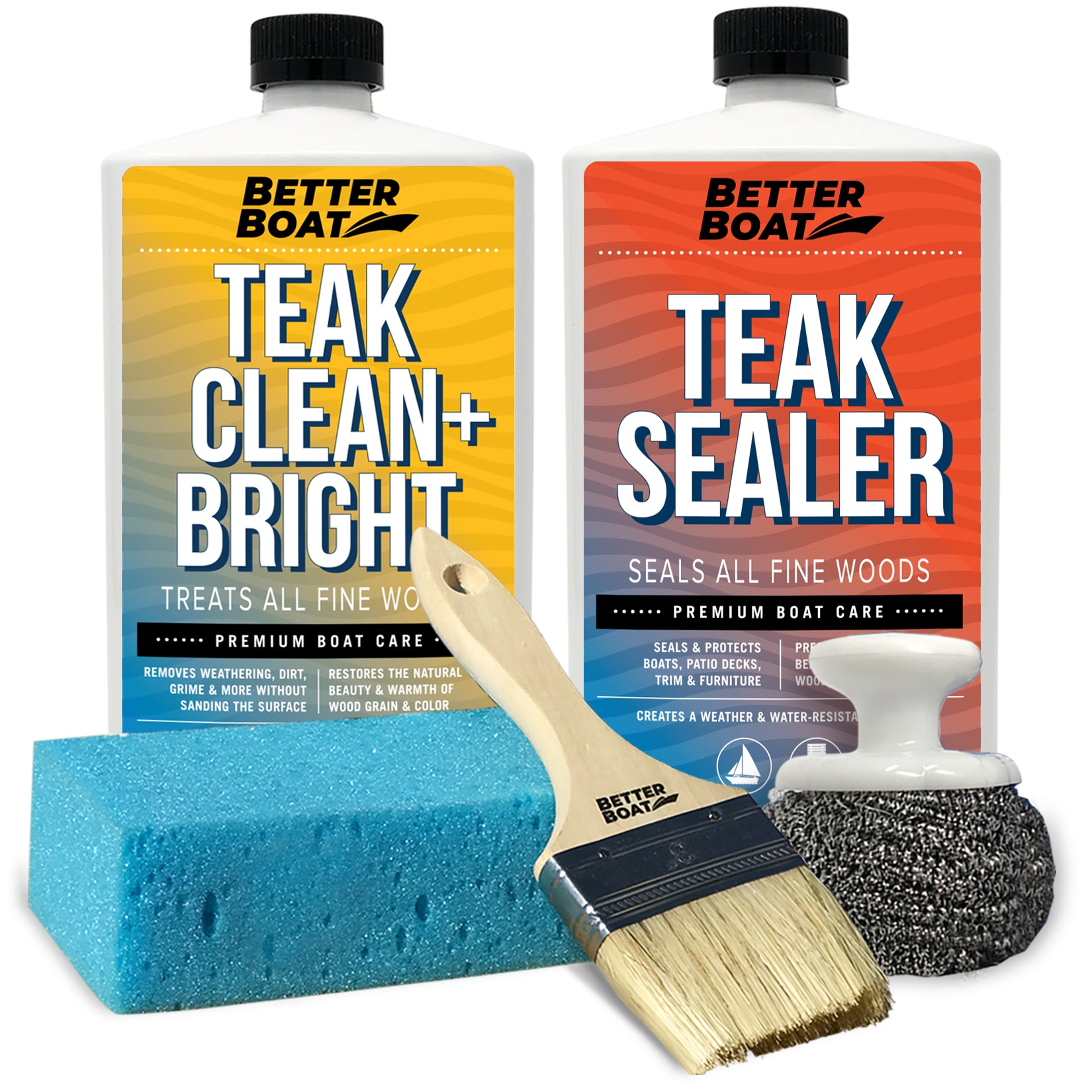
Complete teak care in one kit
Teak Cleaner Brightening and Sealer Set
The Teak Cleaner Brightening and Sealer Set covers cleaning, brightening, and protection in a matched system, so you're not piecing together products from different formulations. It's the straightforward way to make sure each stage of the restoration works with the next.
A smooth project usually comes down to this checklist:
| Item | Why it matters |
|---|---|
| PPE | Protects you from cleaner, solvent, dust, and debris |
| Brush and towels | Gives you control during cleaning and rinse stages |
| Sander and discs | Lets you level weathering without hacking up the deck |
| Seam tools | Makes old caulk removal cleaner and more precise |
| Vacuum and solvent | Preps seams for better adhesion |
| Tape and caulk supplies | Keeps seam work neat and serviceable |
Set everything out before you begin. Teak work rewards patience, and it punishes interruptions.
The Two-Stage Cleaning and Brightening Process
Most decks don't need sanding first. They need an honest wash. Dirt, salt, old oils, and embedded grime can make a serviceable deck look worse than it is.

Stage One: Clean the Wood, Not Just the Surface
Start with a dedicated teak cleaner and work in small sections. Don't flood the whole deck and then chase it. Keep the area manageable so you can scrub, monitor the reaction, and rinse before the cleaner dries where you don't want it.
A teak cleaner and brightener is the right starting point here, handling the grime and grey weathering before you ever think about sanding.

What you need for this step
Teak Cleaner and Brightener
A dedicated teak cleaner cuts through salt, old oils, and embedded grime without the abrasion that damages soft grain. Work section by section, scrub, monitor, and rinse before the product dries where it shouldn't.
If you want a practical walkthrough of teak cleaning basics, this Better Boat article on cleaning teak wood is a useful companion before you start. The Teak Cleaner and Brightener handles both the cleaning and brightening stages in one system.
Use a brush with enough bite to lift grime from the grain. What matters most is control. Scrub firmly, but don't try to carve the wood clean. The deck should look cleaner after this stage, but not necessarily warm or even-toned yet.
A few habits make a visible difference:
- Work in sections: Small areas are easier to rinse thoroughly.
- Keep the surface wet while cleaning: Dried cleaner can leave uneven results.
- Use even pressure: Random hard scrubbing creates patchy appearance.
- Watch the runoff: If it's still dirty, you may need another pass in that area.
Skip the Pressure Washer Reflex
Boat owners love fast tools. Teak usually doesn't. High-force washing can tear soft grain, open up weak areas, and leave the surface fuzzy. If you're comparing methods, this power washing vs. pressure washing guide is a good reminder that surface-cleaning force and heat change how materials respond. On teak decks, restraint beats aggression.
If a deck only gets clean when you attack it, the method is probably wrong.
Stage Two: Bring the Color Back Into Balance
Cleaning removes contamination. Brightening corrects the look. That second step is what often pulls teak out of the dull, flat phase and back toward a cleaner natural tone.
Apply the brightener according to the product directions, keep your coverage even, and rinse thoroughly. Uneven dwell time usually shows up later as blotchy color, so stay organized and move with purpose.
This walkthrough is helpful if you want to see the process before doing it yourself:
What Works and What Doesn't
What works is patience. Clean a section, rinse it well, brighten it evenly, and let the wood tell you what comes next. If the teak still looks weathered after proper cleaning and brightening, then sanding may be justified.
What doesn't work is trying to solve heavy staining, gray oxidation, and seam neglect in one rushed pass. That's how owners end up over-scrubbing and then over-sanding.
After the deck dries, inspect again. You'll get a much clearer read on seam condition and surface wear once the grime is gone.
Sanding Techniques and Seam Repair
Sanding is where teak deck restoration can improve quickly or go wrong permanently. Every pass removes material. You don't get that wood back.
Sand Only as Much as the Deck Can Afford
Teakdecking Systems recommends starting at 80 grit and using 60 grit only for badly weathered teak when the deck has enough thickness, and it warns that the sander must stay moving because pausing creates depressions and over-sanding is a common mistake, as outlined in its guidance on sanding a teak deck.
That advice lines up with what works in the field. Start less aggressive than your frustration wants. Let the paper do the work. Check the surface often. The goal isn't to erase every sign of age. The goal is to restore the deck without thinning it unnecessarily.

If you need a refresher on abrasive choice before touching the sander, this guide to different grits of sandpaper helps sort out when to stay coarse and when to back off.
How to Sand Without Making Dips
The biggest sanding errors are usually mechanical, not technical. People stop in one place, lean on an edge, or chase a stain until they hollow the board.
Use this sequence:
- Dry the deck completely: Damp teak clogs paper and hides the actual surface.
- Clear loose debris: Any grit left on deck scratches unpredictably.
- Make full, controlled passes: Don't hover over a dark patch.
- Keep the sander moving: Motion prevents low spots.
- Stop early rather than late: Slight weathering is better than a thin deck.
Workshop habit: If the surface is almost where you want it, stop and reassess. Most ruined teak was sanded for one more minute.
A faint silver cast on some planks after sanding isn't always failure. Chasing absolute uniformity often removes more teak than the deck can spare.
Seam Repair Lives or Dies on Cleanliness
A damaged seam doesn't need guessing. It needs proper removal and proper prep. A practical restoration workflow includes a deck survey, seam extraction with a reefing hook or Dremel, removal of seam debris with vacuum or compressed air, solvent wiping with acetone on a lint-free rag, and seam masking or bond-breaker tape before re-caulking, as shown in this teak seam repair video demonstration.
That order matters. If old residue stays in the seam base, the fresh caulk may look fine at first and then fail early.
Here's the part many DIY jobs skip:
- Remove failed caulk completely: Don't leave weak material in the seam.
- Vacuum the seam thoroughly: Dust blocks adhesion.
- Wipe with acetone on a lint-free rag: Clean sidewalls matter.
- Use bond-breaker tape when needed: This helps control where the caulk bonds.
- Recaulk neatly and leave cure time alone: Smearing or rushing cure creates more rework.
Know When to Stop
If seam failures are everywhere and sanding exposes how little teak remains, restoration may no longer be a repair project. It's a holding action. That's the point where many owners should step back and price a bigger deck solution rather than keep feeding the cycle.
A repaired seam on a sound deck makes sense. Rebuilding one seam after another on a thin deck usually doesn't.
Choosing Your Finish: Oiling vs. Sealing
Once the deck is clean, dry, and repaired, the finish question comes up fast. Some owners want the traditional warm look of oil. Others want something that holds up with less frequent attention.
If you want both warmth and protection in one step, a teak sealer oil applied after cleaning and brightening covers that finish question cleanly.

Match the finish to your routine
Teak Sealer Oil
Teak Sealer Oil gives owners a single product that bridges the classic warmth of oil with a more controlled application process. Thin, even coats on a fully dry deck are what separate a lasting result from a blotchy one.
Neither choice is automatically right. The right finish depends on how you use the boat, how much upkeep you'll do, and how much visual change you're willing to accept.
What Oil Does Well
Oil gives teak that classic, rich look many owners love. It tends to deepen tone and make fresh restoration look finished quickly.
The tradeoff is maintenance. An oiled deck usually asks for more regular attention, and if the application gets heavy or uneven, the surface can darken in ways some owners don't like. On workboats and high-use recreational boats, that can become one more recurring task on an already full list.
What Sealer Does Better
Sealers appeal to owners who want a more controlled maintenance routine. The look is different from oil. Usually less saturated, often more restrained, sometimes closer to a maintained matte finish depending on the product.
That difference is exactly why many practical boat owners prefer it. They're not chasing the deepest color. They're trying to protect the deck and cut down on repetitive work. The Teak Sealer Oil is a good option for owners looking for durable protection with a manageable maintenance schedule.

Side by Side Decision Points
| Factor | Oiling | Sealing |
|---|---|---|
| Look | Richer, warmer tone | More controlled, less oily appearance |
| Upkeep | More frequent touch-ups | Usually easier to manage over time |
| Forgiveness | Simple to apply, easy to overapply | Needs cleaner prep and even application |
| Best fit | Owners who like a classic look | Owners who prioritize lower routine maintenance |
If you've ever compared paint versus stain on exterior wood, the thinking is similar. Wheeler Painting's paint or stain tips are useful because they frame the decision around maintenance style, not just appearance. That same logic applies to teak.
Pick the finish you'll maintain, not the one you admire for one week after application.
The Practical Choice
For a boat that sees regular use, a sealer often makes more sense than owners expect. For a showpiece look with hands-on upkeep, oil still has its place.
Whichever route you choose, thin coats, clean applicators, and full drying time matter more than brand loyalty. Most blotchy teak finishes come from rushed prep or uneven application, not from the category itself.
Maintenance Schedule and Project Costs
The cheapest teak deck restoration is the one you don't have to repeat prematurely. Maintenance is what decides that, not the before-and-after photos on day one.
Teakdecking Systems notes that a properly maintained deck can last 5 to 15 years, and its preservation guidance includes cleaning, inspecting for needed repairs, and lightly sanding once each year. The same reference also cites Practical Sailor's benchmark that for a modern 12-millimeter teak deck, about 30 years of use is all you can hope for unless the boat has received exceptional upkeep, as summarized in Teakdecking Systems' guidance on extending teak deck life.
The Maintenance Routine That Pays Off
You don't need a complicated ritual. You need consistency.
A sensible annual pattern looks like this:
- Light cleaning: Remove salt, dirt, and grime before they settle in.
- Inspection of seams and edges: Catch loose or detached caulking early.
- Spot correction: Handle small issues before they spread.
- Light sanding only when justified: Don't sand because you feel like doing something.
That last point matters. Sanding isn't seasonal decoration. It's material removal. Use it when the condition calls for it, not because the calendar says so.
What Restoration Can Cost
The economics matter, especially when you're deciding whether to restore again or move on to replacement. One industry estimate puts small yachts under 30 ft at roughly $1,500 to $4,000, mid-sized yachts 30 to 50 ft at $4,000 to $8,000, and large yachts 50 ft or more at $8,000 to $15,000 or higher for teak-deck restoration. The same estimate breaks work into $10 to $20 per square foot for light restoration and $20 to $35 per square foot for moderate restoration, according to this cost guide for teak deck restoration.
That range is why honest assessment matters upfront. A cosmetic refresh on a sound deck is one thing. Deep cleaning, sanding, and seam repair across a failing deck is another.
Common Mistakes After the Job Is Done
Owners usually lose ground in familiar ways:
- Ignoring small seam failures: Water gets time to work where it shouldn't.
- Cleaning too aggressively: Harsh methods wear the surface faster.
- Applying finish over damp wood: Results turn uneven fast.
- Waiting too long between inspections: Small repairs become restoration jobs.
If your deck grays again sooner than expected, don't panic and don't reach for coarse paper first. Check whether the problem is just surface weathering or whether moisture and seam issues are starting to show up underneath.
A teak deck rewards measured work. That's true at the start, and it's even more true after the restoration is finished.
If you're maintaining a boat yourself, keep the process simple and use products made for marine surfaces. Better Boat offers teak care, cleaning supplies, brushes, microfiber towels, sealants, and other practical maintenance gear that can help you handle deck work without piecing your setup together from random household substitutes.
Ready to restore your teak deck? The Teak Cleaner Brightening and Sealer Set is available at betterboat.com.


